Voice AI 10 min read
Voice AI for Service Businesses and Its Honest Limits
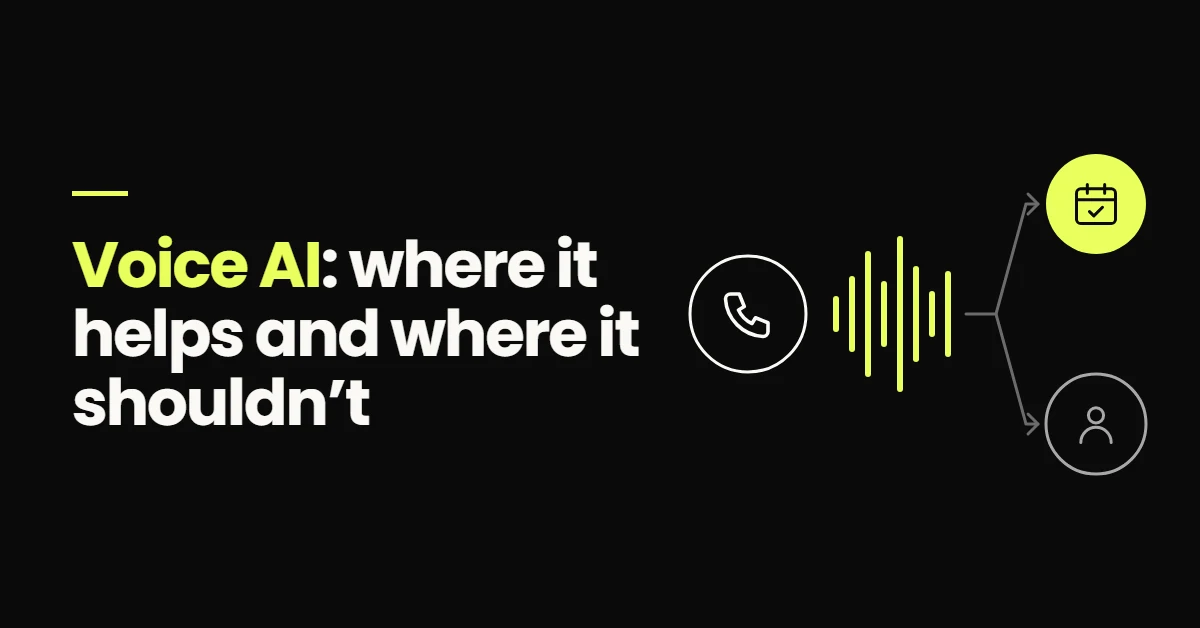
An AI voice agent can pick up the calls your team cannot and book the straightforward ones. It should not handle calls that need judgement or care. How to tell the difference, and how to set it up so callers can always reach a person.
On this page
Voice AI has improved quickly, and the sales pitch has grown faster than the technology. An AI agent can now answer a phone call in a natural voice, understand what the caller wants and book an appointment. It can also mishandle a distressed caller, get stuck on an unusual request, or frustrate someone who just wants to speak to a person.
Voice AI for service businesses works when it is pointed at the right calls. This guide covers where it helps, where it should not be used, and how to set it up so that every caller who needs a human can reach one.
Voice AI for service businesses is software that answers or places phone calls with a synthetic voice, holds a structured conversation and takes actions such as creating a CRM record, booking an appointment, sending a text summary or transferring the call. It helps most with after-hours calls, overflow and missed calls, basic qualification, scheduling and simple repeated questions. It should hand off to a person for emotional, complex, urgent or unusual calls, and it should support a receptionist rather than replace one.
What voice AI actually does on a call
A voice agent runs a loop: it turns the caller's speech into text, decides what to say based on its instructions and approved knowledge, speaks the reply, and takes actions when the conversation calls for them. For a business, what matters is what it can do during and after the call:
- 01Answer and greet Pick up straight away with your business name and a clear statement that it is an automated assistant.
- 02Understand the request Work out whether the caller wants to book, reschedule, ask a question or speak to someone.
- 03Collect details Name, number, service needed, location and timing.
- 04Take action Book into a calendar, create or update the contact, transfer the call, or send a text.
- 05Leave a record A transcript and summary on the contact, so the team knows what happened.
What it cannot do is use judgement the way an experienced person does. It follows instructions and patterns. When a call goes outside them, the quality of the handoff decides whether the caller is helped or lost.
Where voice AI helps service businesses
After-hours calls
Calls outside working hours usually go to voicemail, and plenty of callers do not leave one. A voice agent can answer, find out what the caller needs, book a routine appointment into the next available slot, and pass anything urgent to the on-call process or the morning team.
Missed-call recovery and overflow
During busy periods, calls ring out while the team is on other lines. Routing unanswered calls to a voice agent after a set number of rings means the caller reaches something useful instead of voicemail. If you are not ready for voice AI, missed-call text-back and lead follow-up automation cover the same gap by text.
Basic qualification
The agent asks the short set of questions your receptionist would: which service, where, how soon. The answers go onto the contact record, so whoever calls back starts with context.
Appointment scheduling
Booking, rescheduling and cancelling routine appointments are structured conversations with a clear outcome, which is where voice agents are most dependable. The agent checks availability, confirms a time and triggers the normal confirmation text.
Appointment reminders
Outbound reminder calls can confirm attendance and offer to rebook. They carry consent requirements, covered below, and for many businesses a text reminder does the same job with less friction. Reminder timing and wording are set out in appointment booking automation.
High-volume repetitive questions
Opening hours, directions, parking, whether you offer a service, what to bring. If your team answers the same questions dozens of times a week, a voice agent can take those calls and keep the line free for the ones that need a person.
How voice AI handles a missed call
- Missed callRings out or after hours
- AI answersWithin a few rings
- QualifiesService, area, timing
- Next stepBook or Hand off
Where voice AI should not be used
Emotionally sensitive conversations
Bereavement, a worrying diagnosis, a family emergency, a customer in distress. These calls need warmth and flexibility that a scripted agent cannot provide, and a mishandled call does lasting damage.
Complex sales
A high-value project with custom scope, several decision-makers or a long conversation about options belongs with a person who can read the situation. Voice AI can book that conversation. It should not try to have it.
Complaints and escalations
An unhappy customer calling back is already frustrated, and reaching an AI that cannot solve the problem makes it worse. Route known customers with open issues, and anyone who sounds upset, to a person.
Urgent or safety-related calls
No heating in winter, water coming through a ceiling, a medical worry. Emergency calls need an immediate path to a person or an on-call line, and the agent should be instructed to give your approved emergency guidance and transfer, not take a message.
Unusual requests and judgement calls
Exceptions to policy, billing disputes, requests the business has never handled before. If the right answer depends on context or discretion, the agent should say so and hand off.
Good use vs human required
Good use
- After-hours and overflow calls
- Booking and rescheduling
- Basic qualification questions
- Hours, directions and common questions
Human required
- Distressed or emotional callers
- Complaints and escalations
- Complex or high-value sales
- Emergencies and judgement calls
When voice AI should hand off to a person
The handoff is the part of a voice AI setup that protects your reputation, so design it before anything else:
- 01A person is always one sentence away "Can I speak to someone?" should trigger a transfer or a clear callback promise, every time.
- 02Warm transfers pass context When a call is transferred, the person receives the caller's name and reason for calling.
- 03Emergencies skip the queue Situations you define go straight to an on-call number.
- 04After-hours callbacks are specific "Someone will call you before 10am tomorrow", not "soon", with a task created so it happens.
- 05Confusion ends the attempt If the agent fails to understand twice, it stops trying and hands off.
Every call, whether handled or handed off, should also send a short summary to the team and log the transcript on the contact record.
Connecting voice AI to your CRM and calendar
A voice agent that is not connected to anything is an expensive voicemail. The value comes from what happens after the call: the contact created with the caller's answers, the opportunity placed in the right pipeline stage, the appointment on the calendar, and a follow-up text sent. How those records drive the rest of the system is the subject of CRM automation.
GoHighLevel's Voice AI agents can answer calls, collect details, book appointments and transfer calls inside the same account as the pipeline, which removes most of the integration work. The wider platform is covered in the guide to GoHighLevel automation. Other voice platforms can do the same through integrations, with more moving parts to test.
Consent, disclosure and call recording
The rules for AI voice calls are stricter than many vendors suggest, especially for outbound calls:
- 01Outbound AI calls need consent In February 2024 the US Federal Communications Commission confirmed that AI-generated voices count as "artificial" voices under the Telephone Consumer Protection Act, so the consent rules for artificial or prerecorded voice calls apply to them.
- 02Tell callers they are speaking to AI Disclosure at the start of the call avoids misleading anyone and sets expectations.
- 03Check recording rules Some jurisdictions require every party's consent to record a call. Announce recording where it applies.
- 04Handle personal data carefully Collect only what the booking needs, and check how your provider stores audio and transcripts.
Inbound calls, where the customer phones you, are not restricted in the same way as outbound calls, but disclosure and recording rules still apply. The FCC declaratory ruling is the primary source for the US position. Treat all of this as a starting point rather than legal advice, and check the rules where you operate.
Testing a voice agent before it goes live
Voice agents fail in ways a script review will not catch. Before putting one on your main number, call it yourself, repeatedly:
- 01The common calls Booking, rescheduling, opening hours, questions about services.
- 02The awkward calls Background noise, strong accents, a caller who changes their mind mid-sentence, long silences.
- 03The handoff calls Asking for a person, sounding upset, describing an emergency.
- 04The local details Street names, town names, staff names and service names, pronounced and spelled correctly.
Then start narrow: after hours only, or overflow only, and read the transcripts every day for the first couple of weeks. Widen its role only when the transcripts show it handling calls the way you would want them handled.
Should voice AI replace a receptionist?
No. A good receptionist does far more than answer calls. They recognise regular customers, calm people down, juggle the schedule when a job overruns, and notice when something is wrong. Voice AI does none of that well.
The better model is coverage. Let people handle calls during the day, use voice AI for after hours, overflow and routine scheduling, and make sure anything the agent cannot handle reaches a person quickly. If your business misses calls mainly because nobody is free to answer, that is where a voice agent is most useful. If calls are answered but leads still disappear, the problem is further along, in follow-up or booking.
For voice or AI agents connected to your own systems rather than an off-the-shelf platform, see custom AI integrations.
- Voice AI answers calls, collects details and takes actions such as booking, texting and transferring.
- It is most useful for after-hours calls, overflow, basic qualification, scheduling and repeated questions.
- Emotional, complex, urgent and unusual calls need a person, and every caller should be able to reach one.
- In the US, outbound AI voice calls fall under the TCPA consent rules for artificial voices. Disclose that callers are talking to AI and check recording rules.
- Use it to extend a receptionist's coverage, not to replace them. Start narrow and read the transcripts.
Sources
- Declaratory Ruling on AI-generated voices under the TCPA, FCC 24-17, Federal Communications Commission, February 2024
- Create, test and deploy a Voice AI agent, HighLevel Support Portal
Frequently Asked Questions
Voice AI for service businesses is software that answers or places phone calls using a synthetic voice. It understands what the caller says, responds according to instructions and approved information, and takes actions such as creating a CRM record, booking an appointment, sending a text summary or transferring the call to a person. It is best suited to predictable calls like after-hours enquiries, scheduling and common questions.
Yes. Calls that ring out during busy periods or arrive outside working hours can be routed to a voice agent instead of voicemail. The agent answers, finds out what the caller needs, books a routine appointment or takes the details, and logs everything on the contact record for the team. Urgent calls should be transferred to a person or an on-call line. Where voice AI is not a good fit, missed-call text-back covers the same gap by SMS.
Yes, when it is connected to your calendar. The agent can check real availability, offer times, confirm a slot and create the appointment, which then triggers your normal confirmation and reminder messages. Booking and rescheduling are among the most reliable voice AI tasks because the conversation is structured and the outcome is clear. Consultations that need discussion before booking are better arranged by a person.
Voice AI should hand off whenever a caller asks for a person, sounds distressed or upset, is complaining, describes an emergency or safety issue, wants to discuss a complex or high-value job, or makes a request the agent has not been configured to handle. It should also hand off after failing to understand the caller twice. The transfer or callback should include the caller's details and reason for calling so they do not have to repeat themselves.
No. A receptionist handles judgement, relationships and problems that voice AI does not handle well, such as calming upset customers, managing a changing schedule and noticing when something is wrong. Voice AI is better used to extend coverage: after hours, during busy periods when calls would ring out, and for routine scheduling or common questions. Everything it cannot handle should reach a person quickly.