AI Chat 11 min read
How AI Chat Lead Qualification Works Before You Ever Reply
A well-built chat agent can answer a visitor, ask the questions your team would ask first, and offer a booking or a handoff before anyone is free to reply. How it works, and where it should stop.
On this page
Someone lands on your website at 10pm, wants to know whether you cover their area and roughly what a job involves, and has two other tabs open. A contact form asks them to wait until tomorrow. A well-configured chat agent answers them now.
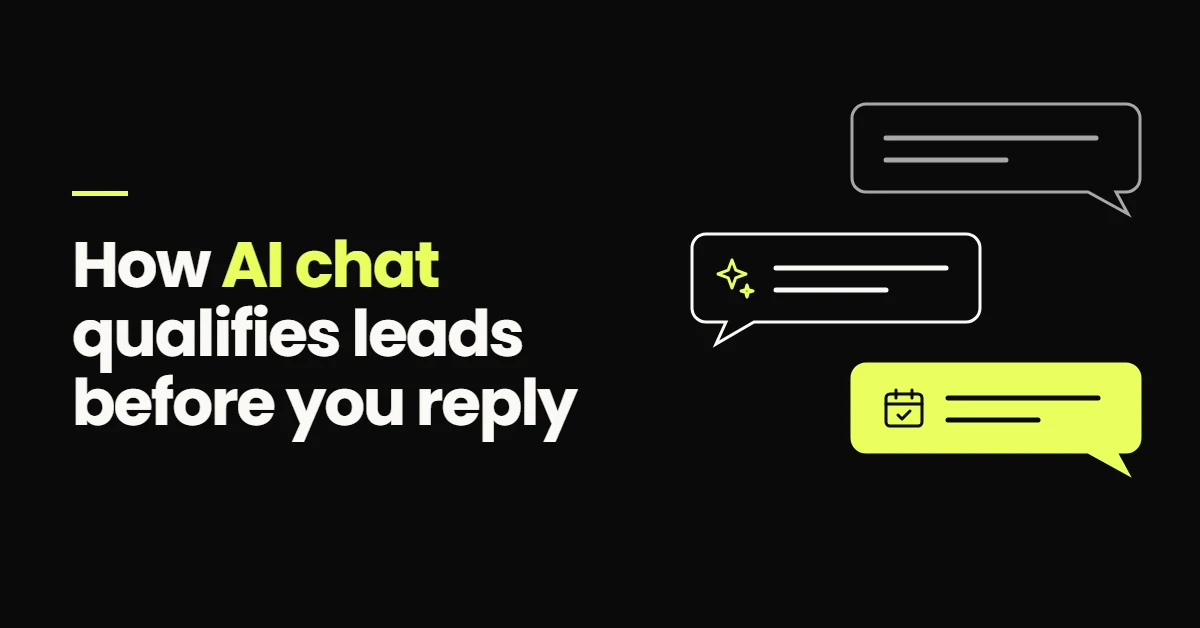
AI chat lead qualification means using a conversational AI on your website or messaging channels to hold that first conversation: answer common questions from information you have approved, ask the questions your team would ask first, record the answers in your CRM, and then offer a booking or hand the lead to a person.
Yes, AI chat can qualify leads, as long as your business defines what qualified means. The AI collects the answers, such as the service needed, location, timing and contact details, while rules you set decide what happens next: book a qualified lead into a calendar, hand a complex or sensitive conversation to a person, or politely redirect a lead you cannot serve. It should not quote custom prices, give professional advice or make promises your team has not approved.
What AI chat does in the lead journey
AI chat sits at the very start of the journey, before a person is involved. Its job is narrower than the marketing around it suggests:
- 01Respond straight away Greet the visitor and answer at any hour, including evenings and weekends.
- 02Answer common questions Services, areas covered, opening hours, how booking works, using information you have approved.
- 03Collect qualifying details The handful of answers your team needs before a first conversation.
- 04Capture contact details Name, phone and email, with consent for follow-up.
- 05Route the conversation Book a slot, hand off to a person, or close politely.
That is the whole job. It is a first conversation, not a salesperson. It does not close deals, negotiate, diagnose problems or replace the person who will do the work.
How AI lead qualification works
Qualification is a decision, and the decision belongs to your business. Before writing a single instruction for the AI, define in plain language what makes a lead worth booking. For most service businesses it comes down to four things:
- 01Fit Do you offer the service they need?
- 02Location Are they inside your service area?
- 03Timing Do they need it soon, or are they researching for later?
- 04Scope Where it matters, does the job fall within the range you take on?
The AI's role is to collect those answers in a natural conversation and apply the rules you gave it. Keep each rule simple enough to state in one sentence: "We cover these postcodes." "We do not take jobs under this size." If a rule needs a long explanation, it is a decision for a person.
How AI chat qualifies a lead
- VisitorAsks a question
- QuestionsOne at a time
- QualifyAgainst your rules
- Next stepBook or Hand off
What questions should an AI chatbot ask?
Fewer than you think. Each question should either change what happens next or save your team from asking it later. Help the visitor first, then ask, one question at a time.
| Question | Why ask it |
|---|---|
| What do you need help with? | Routes the conversation to the right service and knowledge |
| Where is the job or appointment? | Confirms the service area before anyone spends time |
| When do you need this done? | Separates urgent work from research |
| Anything we should know before booking? | Captures details the team would otherwise ask for |
| Best number and email to reach you? | Makes follow-up and confirmations possible |
Three to five questions is usually enough. If a visitor has to answer eight questions before getting anything useful, the chat has become a form with extra steps, and people abandon forms too.
-
Visitor
"Do you fix air conditioning in Plano? Mine has stopped cooling." A question and a service need in one message.
-
AI
"Yes, we cover Plano. Is the unit running but blowing warm air, or not turning on at all?" Answers first, then asks one question that helps the technician.
-
Visitor
"Running, but the air is warm." The answer is saved to a field on the contact record.
-
AI
"Thanks. We have repair visits tomorrow at 9am or 1pm. Would either work? I will need your name and mobile number to confirm." Offers real availability and asks for contact details at the point they are needed.
-
Visitor
"Is it going to cost a lot?" A pricing question with no fixed answer.
-
AI
"It depends on what the technician finds, so I cannot quote it here. Our call-out fee is listed on our pricing page, and I can ask someone to call you with more detail if you like." Declines to guess, shares only approved information, and offers a person.
Capturing contact details without turning chat into a form
Ask for contact details when there is a reason the visitor can see: to confirm a booking, send a quote, or arrange a callback. Asked up front, before any help is given, the same request feels like a gate.
Ask for a mobile number if you follow up by text, and say so. Where you collect a number for messages, include consent wording that matches how you will use it. The sequence that runs afterwards is covered in lead follow-up automation.
Routing, booking and handoff
Booking inside the chat
When a lead qualifies, the chat should offer real availability rather than a generic link, then confirm the booking in the conversation. From there the calendar's own confirmations and reminders take over, as described in appointment booking automation.
Routing to the right place
Answers from the chat should become fields on the contact record, not only lines in a transcript. That lets your CRM route the lead to the right person or pipeline by service and location, as described in the guide to CRM automation.
When to hand off to a person
A good chat agent knows when to stop. Hand the conversation to a person when the visitor:
- 01Asks for a person Always honour it, straight away.
- 02Is unhappy or complaining An existing customer with a problem needs a human response.
- 03Describes something urgent or unsafe A gas smell, a flood, a medical concern. Give the emergency route you have approved, then escalate.
- 04Asks for a price that depends on the job Share only approved ranges, then offer a callback.
- 05Has a complex or unusual request Anything outside the situations the agent was set up for.
- 06Keeps getting answers that miss the point Two failed attempts to help is enough.
What the person receives
The handoff should arrive with a short summary, the answers collected and the full transcript on the contact record, plus a notification to whoever is responsible. Nobody should have to ask the lead to repeat themselves.
After-hours coverage
After hours is where AI chat earns its place for many service businesses. Evening and weekend visitors get answers, qualified leads book the next available slot, and everything else becomes a clear handoff queue for the morning.
Be honest about it. Tell visitors they are chatting with an automated assistant, and when a person will pick up anything it cannot handle. "Someone from the team will reply by 9am tomorrow" is a promise people can plan around. Pretending a person is online is not.
Guardrails for what AI should and should not decide
What AI handles and what a person handles
AI handles
- Approved answers to common questions
- Collecting qualifying details
- Offering available booking slots
- Routing and summarising for the team
A person handles
- Custom prices and quotes
- Complaints and upset customers
- Urgent or safety-related situations
- Exceptions to your usual rules
Guardrails are the difference between a useful agent and a liability. These are the ones I put on every build:
- 01Answer only from approved information A knowledge base you wrote and review, not whatever the model guesses.
- 02Never invent prices, availability or policies If the answer is not in the approved information, say so and offer a person.
- 03Say it is automated Tell visitors they are talking to an AI assistant.
- 04Keep a fallback A standard handoff message when the agent is unsure or the conversation loops.
- 05Review transcripts Read a sample every week at first, then monthly, and fix the answers that went wrong.
Privacy considerations
Collect the minimum the next step needs. A chat agent does not need a date of birth to book an estimate, and it should never ask for payment card numbers in a chat window.
Tell visitors how their information will be used, link to your privacy policy from the chat, and keep transcripts only as long as you need them. Check where your chat provider stores conversations and whether it uses them to train models.
Healthcare and other regulated businesses need extra care. In the US, a HIPAA covered entity that lets a vendor handle protected health information generally needs a business associate agreement with that vendor, so confirm whether your chat platform will sign one before symptoms or treatment are discussed in chat. HHS guidance on business associates explains the requirement. This is general information, not legal advice.
What bad AI chat implementations look like
- 01A pop-up that interrupts immediately The visitor closes it before reading the page and never opens it again.
- 02A bot pretending to be a person It unravels on the first unexpected question and damages trust.
- 03Eight questions before any help A form with extra steps, and a worse one.
- 04Loops with no exit "I didn't understand that" three times, with no way to reach anyone.
- 05No connection to the CRM The chat collects details that never reach a record, so nobody follows up.
- 06A knowledge base nobody updates Old prices, old hours, services you stopped offering.
Is AI chat suitable for every service business?
No. AI chat is worth adding when your website gets steady traffic, especially from paid campaigns; when a meaningful share of enquiries arrive outside working hours; when your team answers the same pre-sale questions every day; or when many enquiries are not a fit and screening them wastes time.
It is not worth it when website traffic is low, when every sale is bespoke and needs a real conversation from the first message, or when most leads call rather than browse. In that last case, voice AI or simple missed-call text-back will help more.
If you already use GoHighLevel, its Conversation AI can handle chat qualification and booking inside the same account as your pipeline, covered in the guide to GoHighLevel automation. For agents connected to your own systems, see custom AI integrations.
- AI chat qualifies leads by collecting answers. Your rules, not the AI, decide what counts as qualified.
- Help first, then ask three to five questions, one at a time.
- Book qualified leads from real availability, and hand off to a person for complaints, urgency, custom pricing and anything unusual.
- Disclose that it is automated, answer only from approved information, and review transcripts regularly.
- It suits businesses with steady website traffic and after-hours enquiries. Phone-heavy businesses may get more from voice AI or missed-call text-back.
Sources
- Business Associates, U.S. Department of Health and Human Services
- Appointment booking in Conversation AI, HighLevel Support Portal
Frequently Asked Questions
Yes, if your business defines what a qualified lead is. An AI chat agent can hold a short conversation with a website visitor, ask about the service they need, their location, timing and other criteria you set, and record the answers in your CRM. Rules you approve then decide the next step: offer a booking, hand the conversation to a person, or explain politely that you cannot help. The AI collects answers and applies your criteria. It should not invent them.
Only the questions that change what happens next. For most service businesses that means what they need help with, where the job or appointment is, when they need it, anything the team should know before booking, and the best phone number and email to reach them. Answer the visitor's own question first, ask one thing at a time, and keep it to three to five questions so the chat does not feel like a long form.
Yes. When the chat is connected to your calendar, it can offer real available slots, confirm the booking in the conversation and create the appointment on the right calendar. Your normal confirmation and reminder messages then run from the booking. Some platforms, including GoHighLevel's Conversation AI, can also pause the bot after booking or pass the conversation to a team member. A booking is only as reliable as the availability the calendar shows.
Hand off when the visitor asks for a person, is unhappy or complaining, describes something urgent or unsafe, asks for a price that depends on the specific job, or has a request outside what the agent was set up to handle. It should also hand off when it has failed to help twice in a row. The person should receive a summary, the collected answers and the full transcript so the visitor does not have to repeat themselves.
No. It helps most when a website gets steady traffic, when many enquiries arrive outside working hours, when the team answers the same pre-sale questions repeatedly, or when a lot of enquiries need screening. It adds little when traffic is low, when every sale needs a tailored conversation from the start, or when most customers phone rather than browse. Phone-heavy businesses usually benefit more from missed-call text-back or voice AI.