The live opportunities board. Stage names, counts and stage values are readable. Every contact name is blurred.
ClientSixth Sense Martial Arts
IndustryMartial arts and fitness
MarketCoppell, Texas
PlatformGoHighLevel and Meta Ads
ServicesAds, CRM, automation, booking
EngagementOngoing support
0101 / Overview
Connecting lead generation with what happens next.
This martial arts marketing automation case study follows one enquiry path from the ad to a recorded outcome. Meta Ads could generate interest in classes and trial programs, but a useful system also needed to manage the enquiry after submission.
The project connected advertising, lead capture, CRM stages, follow-up, trial booking, appointment status, and no-show recovery inside one operational flow.
01Meta ad
02Lead
03CRM
04Follow-up
05Trial booking
06Appointment
07Outcome
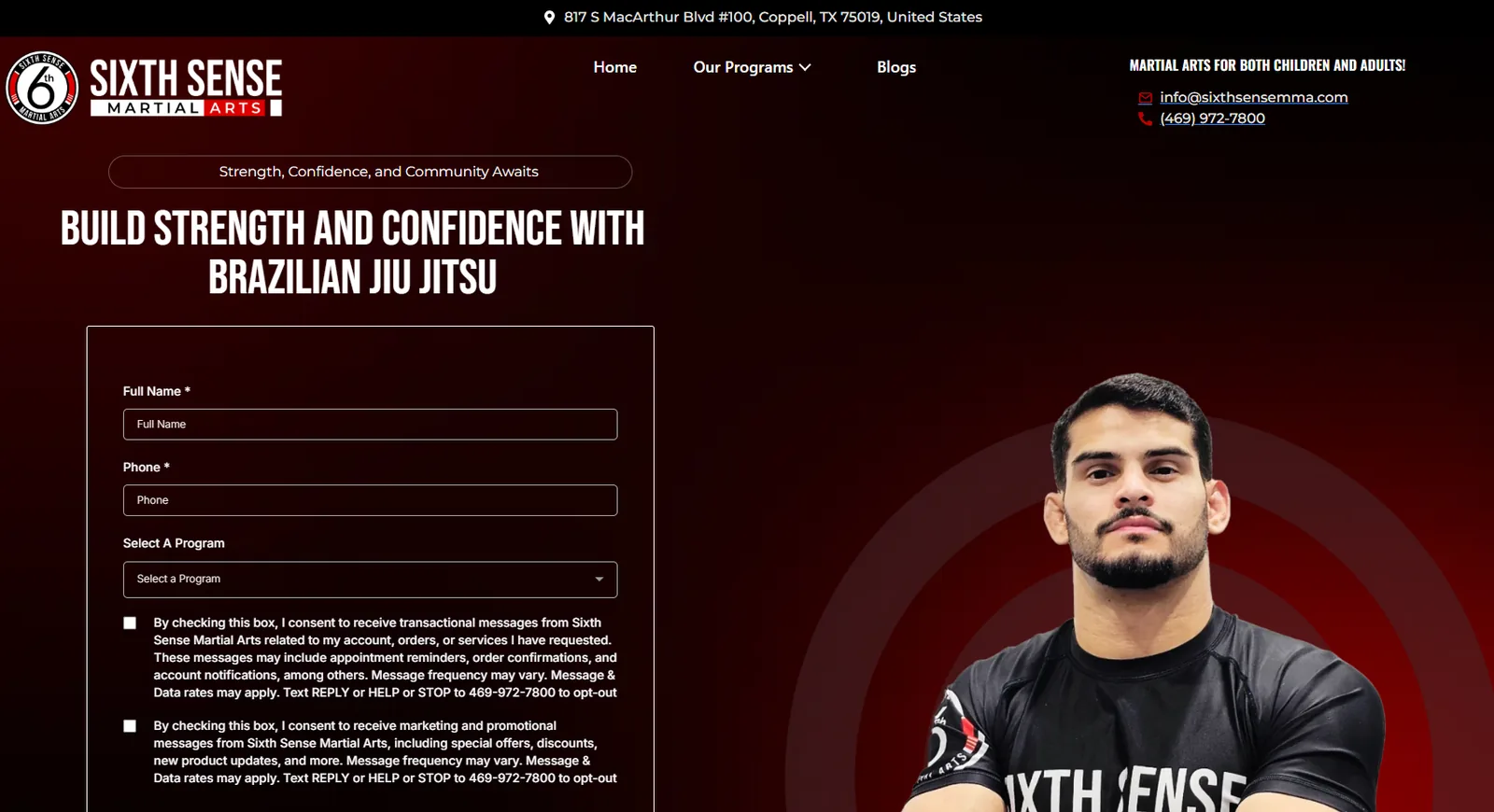
The academy website. One of two destinations campaign traffic reaches, alongside the dedicated trial offer page shown later.
0202 / The challenge
Generating a lead does not guarantee that the lead is managed.
The system was designed to prevent a set of common gaps. I am not claiming every one of them existed here beforehand, because I did not audit the prior state in a way that would let me say so.
Status
Leads entering without a clear status, so nobody can say where an enquiry stands.
Speed
Slow or inconsistent follow-up, depending on who is free and whether anyone remembers.
Ownership
No visible lead owner, so an enquiry can sit with everyone and nobody.
Tracking
Trial enquiries becoming difficult to track once the conversation moves off the form.
Appointments
Bookings not reflected in the pipeline, so the CRM and the calendar disagree.
No-shows
Missed appointments receiving no structured next step and quietly dropping out.
Attribution
Advertising data staying disconnected from CRM activity.
Visibility
Staff having limited view of the current lead stage.
Result
Spend continues while enquiries already paid for go unworked.
The path the system was built to replace
01Lead submitted
02Inbox
03Manual follow-up
04Unclear status
05Lost context
The path that was built
01Lead submitted
02CRM
03Pipeline
04Workflow
05Booking
06Tracked outcome
0303 / Solution
One connected acquisition and follow-up system.
Ten steps between the ad impression and a recorded outcome. Only the first two happen inside Meta.
01Meta Ads
Campaigns run against class enquiry and trial objectives.
02Lead form or landing page
The enquiry is captured through a defined entry point rather than a direct message.
03GoHighLevel contact
The person is stored once, with the information the follow-up needs.
04Source recorded
The campaign that produced the enquiry stays attached to the record.
05Pipeline entry
The opportunity opens at New Lead, so its position is visible immediately.
06SMS and email
Follow-up begins without anyone remembering to start it.
07Trial booking
The prospect can schedule a trial class from the follow-up itself.
08Appointment tracking
The booking is reflected against the opportunity, not only in the calendar.
09No-show recovery
A missed trial triggers a defined next step instead of ending the thread.
10Outcome
The opportunity closes at a stage that reflects what actually happened.
A lead is not valuable simply because it entered a form. It becomes useful when the business can see its source, status, owner, next action, booking state, and final outcome.
0404 / Acquisition
Campaigns designed around a clear next action.
The campaign objective was connected with the operational next step. A lead needed to enter the CRM and move toward a trial booking rather than remain only a platform submission.
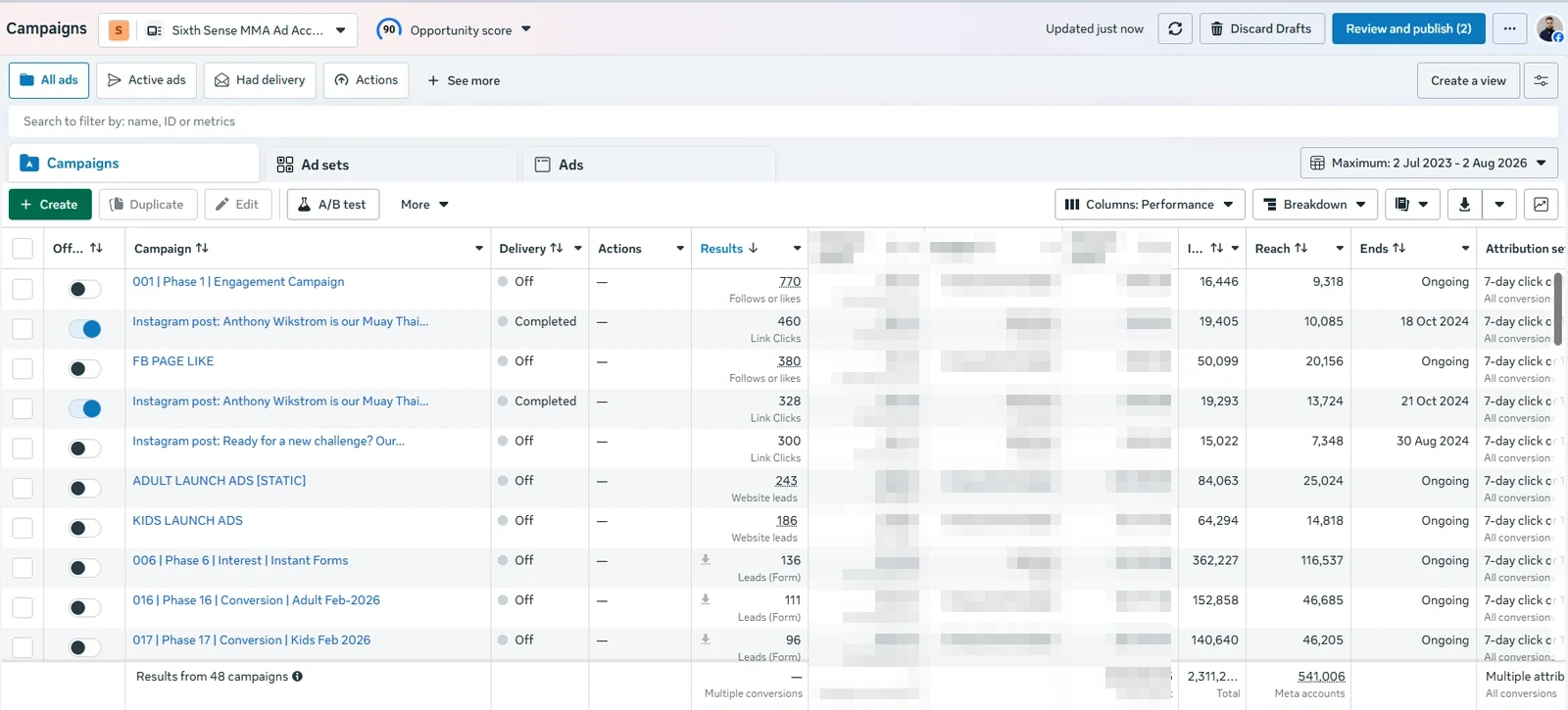
Meta Ads Manager, campaign view. Budget, cost per result and spend columns are redacted because those figures belong to the client. Campaign names, delivery state, results and reach are left readable.
Objectives in use
The account runs engagement campaigns, website lead campaigns, and instant form campaigns side by side rather than one objective throughout.
Program targeting
Campaign names separate adult and kids programs, so enquiries arrive already segmented by who the class is for.
Phased structure
Campaigns are numbered in phases, which makes it possible to see what was tried and in what order.
What I supported on the acquisition side
Meta Ads campaign support
Lead generation campaigns for class enquiries
Trial program promotion
Audience planning
Ad copy support and creative direction
Instant forms and landing page connection
Campaign monitoring
Connection into the CRM so the source stays attached
Paid acquisition was the engine, so it is worth knowing what organic was doing underneath it.
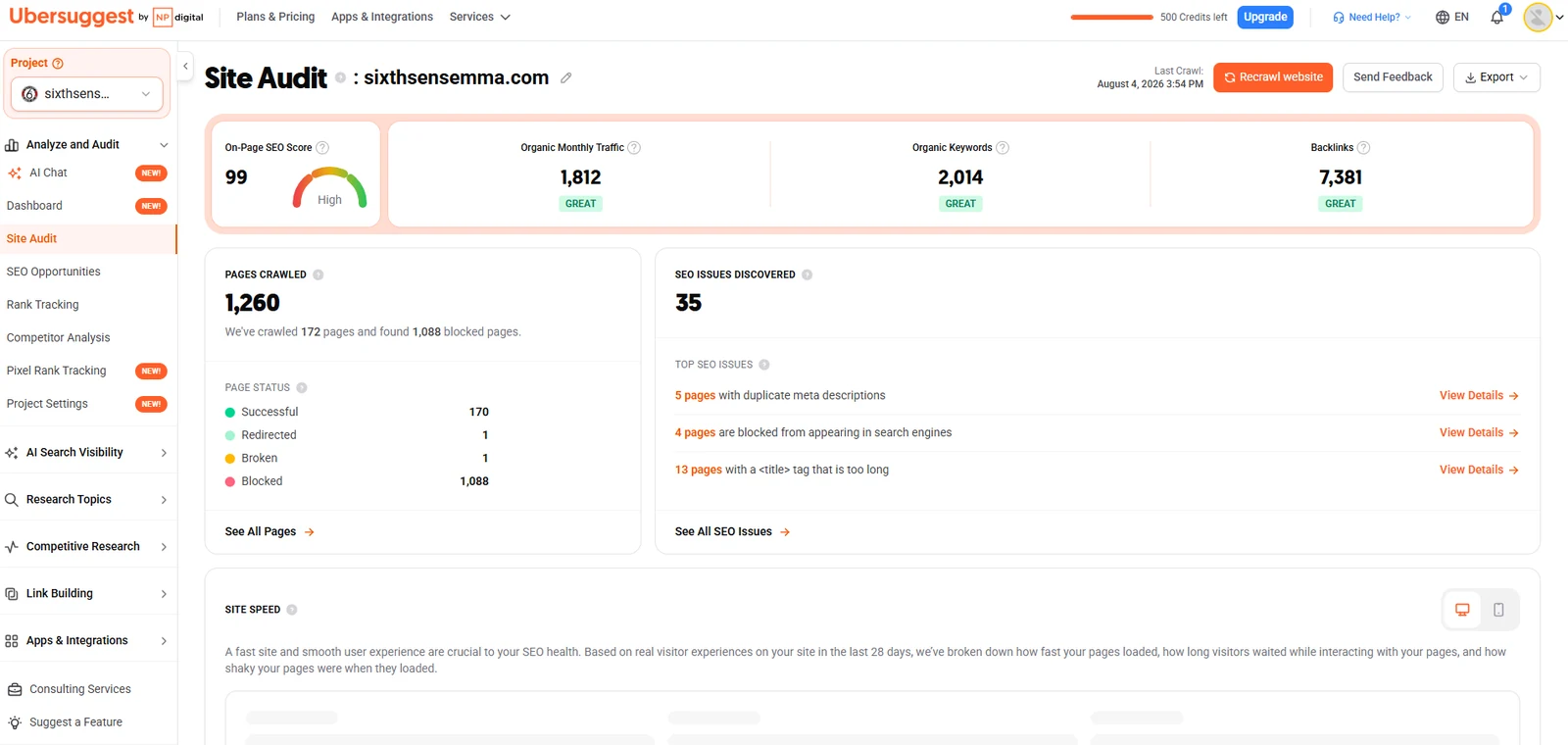
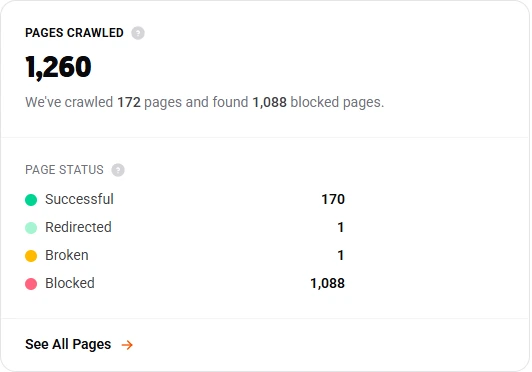
This is a third-party site audit of sixthsensemma.com, crawled on 4 August 2026. It is context for the paid and CRM work rather than a result I am claiming, because search was not part of the engagement.
Ubersuggest Site Audit, sixthsensemma.com, last crawl 4 August 2026. Nothing in this view is redacted, because nothing in it is private. The account avatar is the tool's default placeholder, not a photograph.
The four headline figures. The first is the tool's score for the pages it could read. The other three are Ubersuggest's own estimates, not measured traffic, not Search Console, and not client analytics.
Measured
What the crawler actually found
These come from the crawl itself, so they are facts about the site on the day it ran.
Reported
1,260 URLs discovered in total
172 of them crawled
1,088 blocked from crawling
170 returned successfully
1 redirected and 1 broken
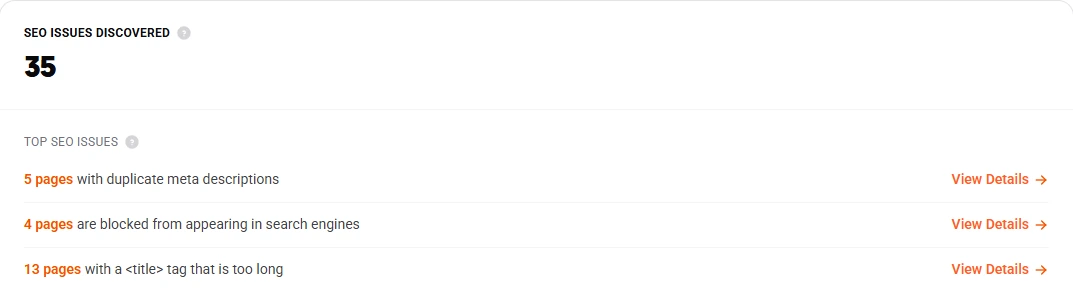
35 SEO issues found across what was read
An on-page score of 99 for those pages
Estimated
What the tool models
These are Ubersuggest's estimates. They are useful for direction and they are not a substitute for the academy's own analytics.
Reported
1,812 organic visitors a month
2,014 organic keywords
7,381 backlinks
Why the distinction matters
A modelled traffic figure and a Search Console figure can differ by a wide margin in either direction. Quoting an estimate as though it were measured is how a case study stops being trustworthy, so both are labelled here and neither is dressed up as the other.
The crawl breakdown, which is the most interesting panel on the page.
The number worth stopping on
1,088 of 1,260 discovered URLs are blocked from crawling. That is most of what the tool could see, sitting directly beside a score of 99 and three green badges.
Blocking at that volume is often deliberate, covering parameter URLs, filters, feeds and admin paths
It can equally be a robots rule that is wider than anyone intended
The audit reports the count and does not say which it is, so neither does this page
Checking which of the two it is would be the first task in any search engagement here
A high score across 172 readable pages says nothing about the 1,088 that were not read
The three issues the audit surfaces first. Five pages with duplicate meta descriptions, four blocked from appearing in search engines, and thirteen with a title tag that is too long. All three are ordinary housekeeping rather than anything structural.
Search was not in scope for this engagement. The work described on the rest of this page is paid acquisition, CRM and automation, and none of the figures above is presented as something I produced.
What this capture does not cover
No Google Search Console or analytics data for this domain is held, so no measured traffic, click, impression, position or conversion figure is stated. No keyword list, ranking for a named term, competitor comparison or link profile detail is published, and none is inferred from the estimates above. The site speed panel was still loading when the capture was taken, so no Core Web Vitals or page speed figure appears anywhere on this page. This is a single audit on a single date, so no trend, change or before and after is claimed.
0606 / CRM pipeline
A pipeline built to make lead status visible.
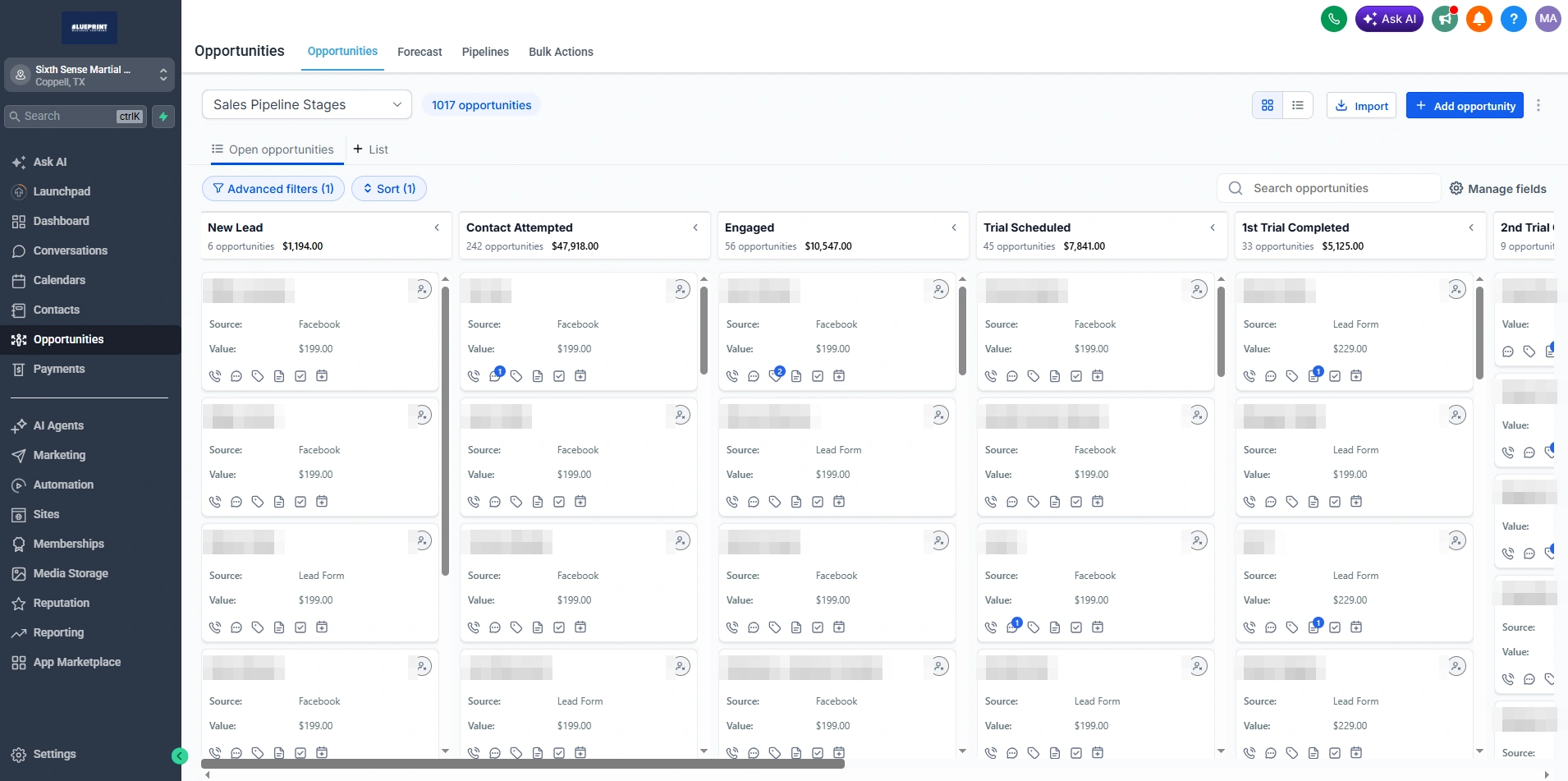
The pipeline holds nine stages. Six are visible in the capture below. The remaining three sit past the horizontal scroll, and I am not naming them here because I will not publish stage labels I cannot show you.
The Sales Pipeline Stages board, filtered to open opportunities. Each stage header carries its own opportunity count and total value. Every contact name is pixelated.
01New Lead
The opportunity opens here the moment the enquiry is captured. Nothing has been attempted yet, so this stage is a queue rather than a status.
02Contact Attempted
First outreach has gone out. The stage separates enquiries somebody has touched from enquiries still waiting.
03Engaged
The prospect has responded. This is the point where automated follow-up should stop and a person should take over.
04Trial Scheduled
A trial class is booked. The opportunity now has a date attached and the reminder sequence becomes relevant.
051st Trial Completed
The prospect attended. Attendance is recorded against the opportunity rather than living only in the calendar.
062nd Trial Completed
A second session attended. Multiple trial stages exist because a martial arts decision is rarely made after one class.
07 to 09Beyond the visible scroll
Three further stages continue the journey to a closed outcome. They are not published here because the capture does not show them and I will not invent labels.
A useful pipeline should show where the enquiry is, who is responsible, and what needs to happen next.
0707 / Automation
Six workflows supporting the lead and appointment journey.
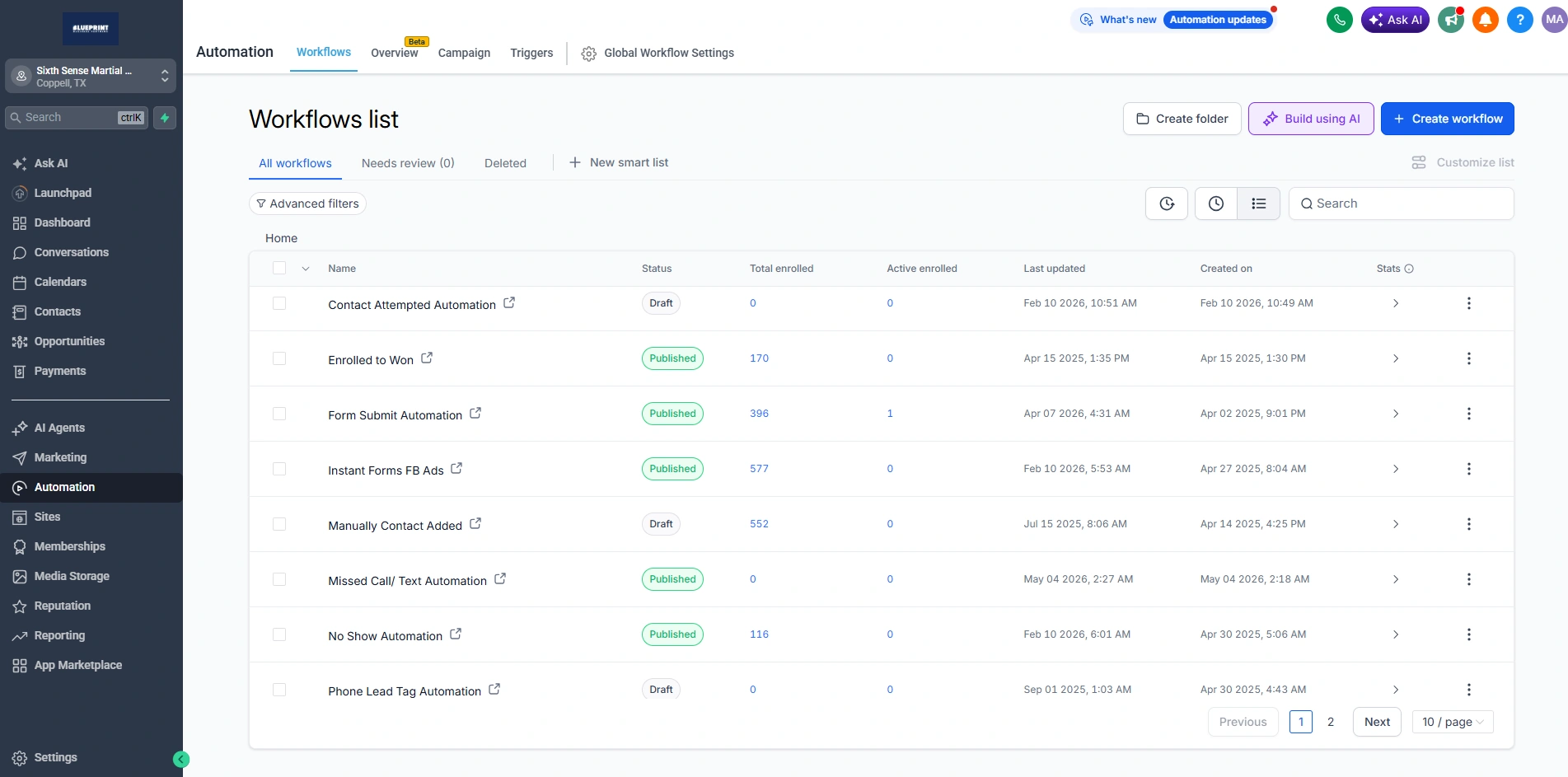
Six workflows are active. The account holds more than six in total, with drafts alongside the published ones, which is normal. The names below are the real workflow names as they appear in the account.
The workflows list. Published and draft states are both visible, along with total enrolled and last updated for each. No message content is exposed.
Instant Forms FB AdsPublished
Catching the ad lead
The entry point for enquiries that arrive through a Meta instant form rather than the website.
TriggerMeta instant form submission
ActionsCreate or update the contact, attach the campaign source, open an opportunity at New Lead, begin first contact
StopReply received, or the opportunity moves past Contact Attempted
PipelineOpens the opportunity
Form Submit AutomationPublished
Catching the website lead
The same job for enquiries submitted through the website or the campaign landing page, so both routes end in the same place.
TriggerWebsite or landing page form submission
ActionsContact created, source recorded, acknowledgement sent, opportunity opened
StopReply received, or a trial is booked
PipelineOpens the opportunity
Missed Call/ Text AutomationPublished
Answering the call nobody could take
Classes run through the evening, which is exactly when enquiry calls arrive. This workflow responds when the phone cannot be answered.
TriggerMissed inbound call
ActionsImmediate SMS back, contact created or updated, team notified
StopReply received, or the call is returned
PipelineEnters the enquiry into the same flow as a form lead
No Show AutomationPublished
The trial that did not happen
A booked trial that nobody attends is the most recoverable loss in the whole system, and the easiest one to let disappear.
TriggerAppointment marked as no-show
ActionsStatus updated, follow-up SMS and email, rebooking link, task raised for the owner
StopA new trial is booked
PipelineMoves the opportunity to the recovery path rather than closing it
Enrolled to WonPublished
Closing the record properly
When a prospect enrols, the opportunity has to be marked won. Without this the pipeline slowly fills with people who already joined.
Follow-up keyed to the Contact Attempted stage rather than to the form submission. Held in draft rather than published, which is why it is not counted among the six active workflows.
TriggerOpportunity enters Contact Attempted
ActionsContinued follow-up until the prospect responds
StopReply received, or stage advances
StateDraft, not currently running
Message content, exact send delays, and enrolled contact records are not published here. What is shown is the structure: what starts a workflow, what it does, what stops it, and how it relates to the pipeline.
0808 / Follow-up
Follow-up that responds to the lead's current stage.
The purpose was not to send more messages. It was to make communication consistent and relevant to the lead's stage.
SMS
Short, immediate, time-sensitive
Used where speed changes the outcome and the message fits in a sentence.
In this system
Initial acknowledgement after an enquiry
Missed call text back
Short follow-up while the lead is still deciding
Trial reminder before the appointment
Rebooking after a no-show
Email
Longer, referenceable
Used for anything a parent or prospect may want to come back to.
In this system
Trial and program details
Booking confirmation
Longer follow-up
Information a decision needs more than one line to explain
Stop on reply
Automated follow-up ends once the prospect responds, so a person is not talking over a workflow.
Stop on booking
A booked trial ends the chasing sequence and hands over to the reminder sequence.
Stage conditions
What sends depends on the pipeline stage, not only on how long ago the lead arrived.
Duplicate protection
A returning enquiry updates the existing contact rather than creating a second one.
Appointment conditions
Reminder and recovery paths branch on appointment status rather than running blind.
Consent
SMS consent is captured on the form itself, at the point of submission.
0909 / Trial booking
Moving an enquiry toward a scheduled trial.
The booking is the point the whole acquisition side exists to reach. Everything before it is preparation and everything after it is delivery.
01New enquiry
02Follow-up
03Booking link
04Trial scheduled
05Confirmation
06Reminder
07Appointment status
How a lead reaches the booking step
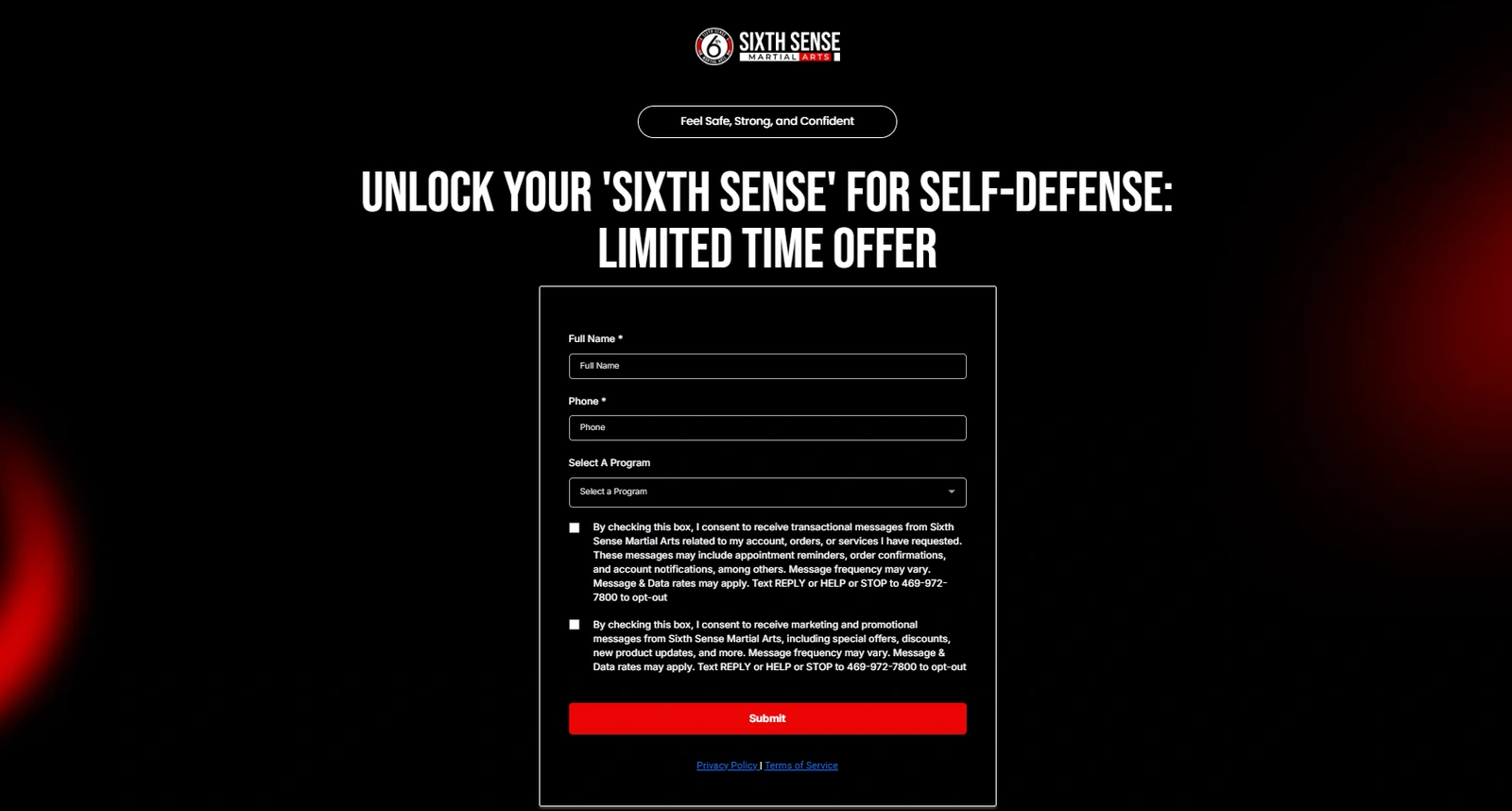
The enquiry form asks which program the prospect wants, so the trial is booked against the right class
Follow-up carries the booking link rather than asking the prospect to find it
A booked trial moves the opportunity to Trial Scheduled, so the pipeline reflects the calendar
Confirmation goes out on booking, and a reminder goes out before the session
Attendance is recorded against the opportunity, not only against the calendar entry
The trial offer page. The program selector is what routes the enquiry to the right class.
1010 / Appointments
The CRM should reflect what happened after the booking.
Without appointment status, advertising reports may show a lead while the business still cannot see whether the person booked or attended.
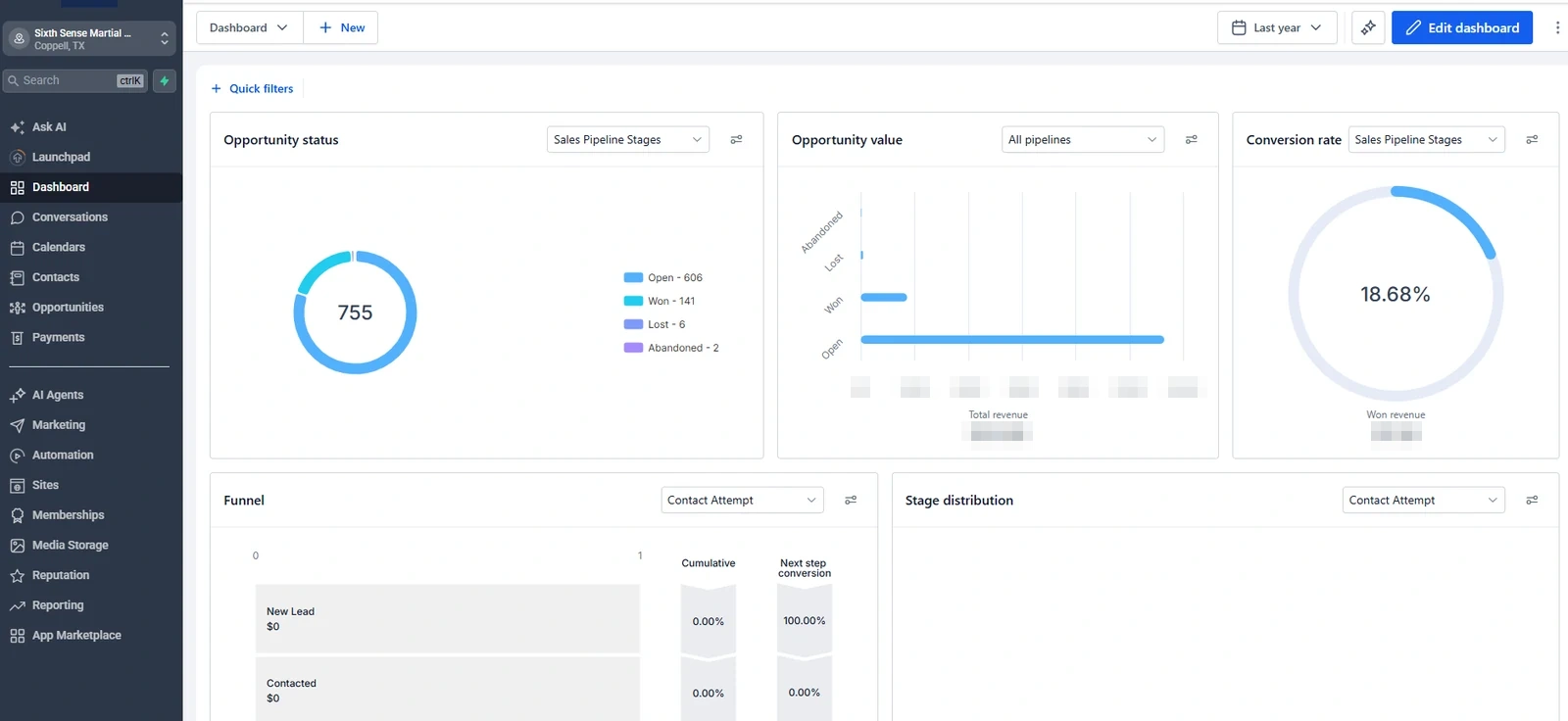
The account dashboard. Opportunity status, stage distribution and the funnel are readable. Revenue figures are redacted because they belong to the client.
Lead created
An enquiry exists. Nothing has been agreed and nothing is scheduled.
Trial booked
A date exists. The reminder sequence becomes relevant from here.
Attended
The prospect turned up. The opportunity advances to a trial completed stage.
No-show
The date passed without attendance. This is a status, not the end of the record.
Rescheduled
A new date replaces the old one and the reminder sequence restarts.
Closed
Won or lost, recorded so the pipeline reflects reality rather than accumulating open records.
1111 / Recovery
A missed appointment still needs a defined next step.
The goal was to prevent missed appointments from disappearing without a clear follow-up action. Whether somebody rebooks is not something a workflow controls. Whether they are contacted is.
01No-show recorded
02Status updated
03Follow-up begins
04Rebooking option
05Team task
06Outcome recorded
Driven by the No Show Automation workflow, which stops as soon as a new trial is booked
Without the workflow
The missed trial ends the thread
The calendar entry passes and nothing changes in the CRM
Nobody is told the appointment was missed
The opportunity keeps its old stage and looks healthy
The lead is effectively lost while still appearing open
With the workflow
The missed trial starts a path
The no-show status is recorded against the appointment
Follow-up SMS and email go out automatically
A rebooking link is included rather than requested
A task is raised so a person picks it up if the automation does not land
The sequence stops the moment a new trial is booked
1212 / Implementation
How the system was structured.
Six areas, all verifiable in the captures above. Nothing listed here is aspirational.
01 Lead sources
Meta instant forms
Website form
Campaign landing page
Inbound calls
Manual entry
02 CRM
GoHighLevel
Contacts
Opportunities
Nine-stage pipeline
Lead status
Source information
03 Automation
Six active workflows
SMS
Email
Pipeline updates
Booking actions
No-show recovery
04 Appointments
Trial booking
Appointment tracking
Reminders
Status updates
Rebooking
05 Reporting
Campaign source
Pipeline visibility
Stage distribution
Appointment status
Opportunity outcome
06 Testing
Lead entry from each source
Workflow entry conditions
SMS and email delivery
Booking path
Pipeline movement
Reply handling
Stop conditions
No-show path
Duplicate behavior
1313 / My role
My contribution across acquisition and automation.
Separated by what I implemented myself and what depended on the academy. I did not teach classes, take sales calls, or run the front desk, and the system only works because people there do.
Built and managed by me
Implementation
Meta Ads campaign support and monitoring
Audience and campaign planning
Lead generation structure across forms and landing page
GoHighLevel CRM configuration
Nine-stage pipeline structure
Workflow development and stop conditions
SMS and email automation
Trial booking setup and connection
Appointment tracking
No-show recovery
Testing and troubleshooting
Ongoing optimization and reporting review
Depends on the academy
Not my scope
Martial arts instruction and class delivery
Sales conversations with parents and prospects
Trial class scheduling capacity
Marking attendance and no-show status accurately
Pricing and enrolment decisions
Day to day academy operations
Automation moves the record. It does not decide whether somebody enjoyed the class.
1414 / Outcome
A clearer path from campaign enquiry to tracked outcome.
No lead counts, cost per lead, booking rates, attendance rates, or revenue figures are published on this page. I have not been given verified numbers I can stand behind, so the outcome below is described operationally rather than numerically. The only figures anywhere on this page are the third-party site audit readings in section 05, which cover search rather than this work.
Connected
Lead generation and CRM activity are connected, so a campaign enquiry has a record rather than only a notification.
Staged
Trial enquiries enter a defined pipeline with nine stages instead of an undifferentiated list.
Automated
Six workflows support the journey from first contact to closed outcome.
Booked
Booking activity is connected with the lead record rather than sitting only in a calendar.
Tracked
Appointment status can be seen against the opportunity, including no-shows.
Recovered
Missed trials have a defined follow-up path with a stop condition.
Staged messaging
SMS and email support different points in the journey rather than duplicating each other.
Visible
The team has clearer visibility into where each enquiry stands.
Actionable
Every campaign lead has a structured next action attached to it.
1515 / Takeaways
What other martial arts academies can learn from this system.
Five things this build makes obvious, all of which apply to any academy running paid enquiries.
01
Lead generation is not the complete result
An ad platform submission still needs ownership, follow-up, booking, and outcome tracking before it means anything.
02
The pipeline should match the trial journey
Stages should reflect real decisions and actions. Separate trial stages exist here because a martial arts decision is rarely made after one class.
03
Follow-up should respond to behavior
Replies, bookings, appointment status, and stage movement should affect what communication happens next.
04
No-shows need a process
A missed appointment should trigger a defined decision rather than disappear from the CRM.
05
Advertising and CRM data should connect
The business needs to understand what happens after the lead is generated, not only how many arrived.
1616 / Related services
Services used in this project.
Three service pages describe the layers this build sits across.
Connect your martial arts leads with a clear booking and follow-up process.
I can review your Meta Ads, lead forms, landing pages, GoHighLevel account, pipeline, workflows, trial booking process, appointment tracking, and no-show follow-up before defining the highest-priority improvements.