Commercial Real Estate Lead Generation Case Study: Buraq Business Center
Buraq Business Center needed a Meta Ads system that could present the commercial opportunity clearly, reach relevant audiences, capture useful enquiry information, and support the sales team's next conversation.
I worked across audience planning, campaign structure, instant forms, property creative direction, lead qualification, campaign monitoring, and ongoing optimization.
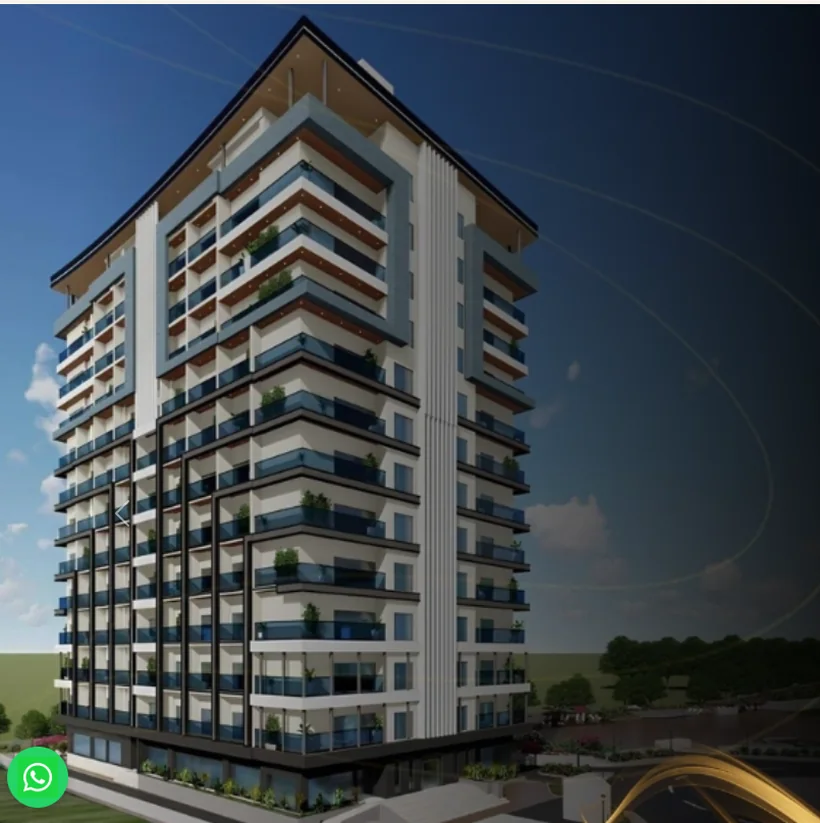
- ProjectBuraq Business Center
- IndustryCommercial real estate
- MarketPakistan
- ChannelMeta Ads
- Campaign typeLead generation
- Lead captureInstant forms
- Developer officeBusiness Bay, DHA Phase 1, Rawalpindi
- EngagementOngoing campaign support
Turning a commercial property offer into a clear digital campaign.
Commercial property advertising requires more than publishing a building render. The campaign needs to explain the opportunity, identify the intended buyer or investor, communicate the location and project value clearly, and capture information the sales team can use.
The work connected the project offer, campaign message, audience, creative, instant form, and lead-quality feedback.
The path the campaign had to carry
- 01Project
- 02Offer
- 03Audience
- 04Creative
- 05Instant form
- 06Sales follow-up
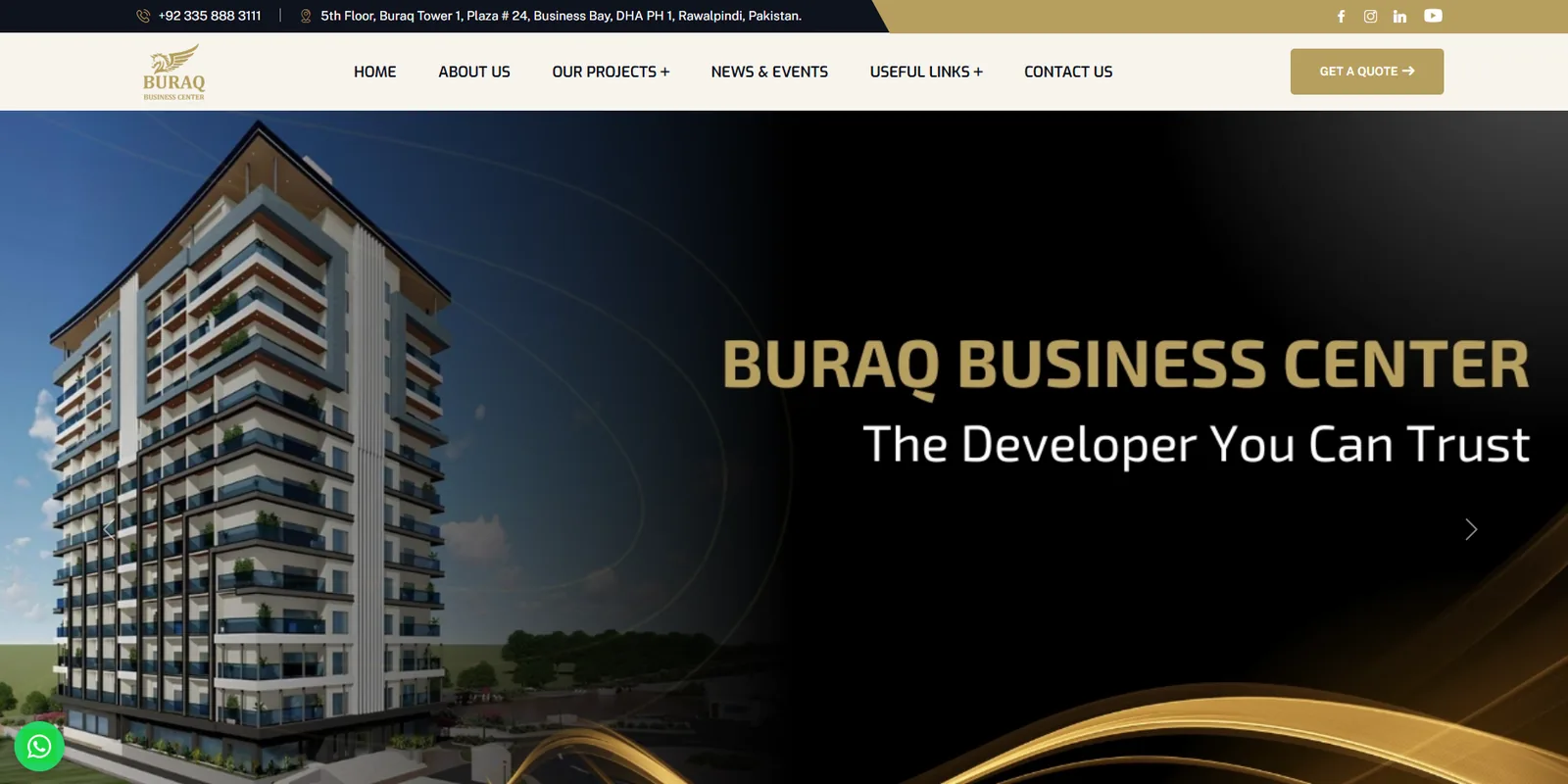
The project as the developer presents it. A single render, a positioning line, and a navigation carrying projects, news and contact. Everything the campaign said had to stay consistent with this.
Property enquiries vary widely in intent and readiness.
A commercial unit is a long decision. The same ad can reach somebody comparing investments seriously and somebody who tapped a render out of curiosity, and the form is what separates them before the sales team spends time.
The campaign structure was designed to reduce common problems such as these. Not every one of them is claimed to have occurred on this account.
Reach 01
- Audience defined too broadly
- Location targeting wider than the real buyer market
- Delivery optimized for the cheapest action
Message 02
- Creative showing a building without explaining the offer
- No location or commercial use context
- Nothing recent to show the project is progressing
Capture 03
- Form asking too little to be useful
- Form asking so much that people abandon it
- No property preference or contact preference
Handoff 04
- Duplicate or unreachable submissions
- Sales team receiving a name and a number only
- Optimization based on platform cost alone
A weak property journey
- 01Ad
- 02Click
- 03Name and phone
- 04Limited context
The journey the campaign was built for
- 01Ad
- 02Property context
- 03Relevant questions
- 04Lead
- 05Sales conversation
- 06Feedback
Start with the property, audience, and required next step.
Planning ran in a fixed order. Each step below only makes sense once the one above it is settled, which is why the form questions were decided near the end rather than at the start.
What is being built, what stage it is at, and what the developer can evidence today.
What a buyer is actually being invited to consider, stated in one line.
Where the development sits and what that means for who it suits.
Which groups of people plausibly want commercial space or a commercial investment.
Which markets are worth paying to reach and which are outside the sales team's range.
What imagery exists, what it proves, and what is missing.
Chosen only after the audience and the offer are settled, never before.
The minimum a salesperson needs to open a useful conversation.
Who contacts the enquiry, how quickly, and through which channel.
How the sales team reports back on whether the enquiries were worth calling.
The campaign should not optimize for form submissions without considering whether those submissions are useful to the sales team.
Relevance matters more than making the audience as large as possible.
Audiences were separated by the job they were doing rather than merged into one large pool, so a poor result could be traced to a specific group instead of the campaign as a whole.
Core
The groups most plausibly in the market for commercial space or a commercial property investment.
- Geographic area
- Age range
- Property interest
- Commercial investment interest
Test
Adjacent groups run separately so their cost and their lead quality could be judged on their own.
- Business ownership
- Entrepreneurship
- Real estate
- Property development
Retargeting
People who had already met the project, where a retargeting audience was implemented.
- Video and page engagement
- Previous form openers
- Profile visitors
Broad
A deliberately open audience kept as a control, so the targeted layers had something to be measured against.
- Location only
- Minimal constraints
- Used as a baseline
Location targeting should match the project's real buyer market.
The development sits in Business Bay, DHA Phase 1, Rawalpindi. That single fact drives most of the geographic decision, because a commercial unit is bought by people who can reasonably visit it or already know the area.
What the radius has to respect
- Project location
- Nearby cities
- Business hubs
- Investor markets
- Property visit feasibility
- Market awareness of the area
What the budget has to respect
- Campaign budget
- Sales team coverage
- Follow-up capacity
- Time zone of any overseas market
- Cost of reaching a distant audience
- Whether a visit is realistic
Paying to reach somebody who can never visit the site is a decision, not an accident, and it needs a reason behind it
The creative had to explain the opportunity before asking for the lead.
A render answers what the building looks like. It does not answer what is for sale, where it is, who it suits, or why now. The creative system had to carry all four before the form was worth opening.
The full explanation
Project identity, the building, the commercial use, and the location in a single frame that still reads on a phone. The feed placement gets the most room, so it carries the most context.
The short version
Vertical, fast, and built around one idea rather than four. Story creative repeats the project identity and one reason to enquire, then hands over to the form.
Construction updates
Recent project work, used because a development that is visibly advancing answers a question no render can.
Project updates
Completion and handover moments, which give the campaign something current to say without changing the underlying offer.
TVC stills
Frames pulled from project video, so the paid creative and the brand film stay recognisably the same project.
The positioning line the campaign had to stay consistent with. Paid creative that contradicts the project's own language costs the campaign credibility before the form ever opens.
Capture enough information to support the next conversation.
Instant forms were the capture method, which the account confirms through a lead generation campaign reporting its results as form leads. The design problem is the trade-off in every question added.
The creative has already explained the project. The form is a continuation, not an introduction.
Restates what the person is enquiring about, so the form does not feel disconnected from the ad.
The fields Meta can prefill. Low friction, and the part most people complete without thinking.
The questions that cost completion rate and buy context. This is where the real decision sits.
Permission to be contacted, stated plainly rather than buried.
Sets the expectation of who will make contact and roughly when.
Every additional question creates friction, but asking too little leaves the sales team without context.
What a qualification question has to earn
- It changes who the salesperson calls first
- It changes what the salesperson opens the call with
- It cannot be guessed from the contact details already collected
- It is something a genuine enquirer can answer in one tap
- It does not ask for information the person would reasonably refuse to a stranger
The same question discipline applies to the lead forms described under paid advertising services
A campaign structure built for testing and clearer decisions.
The account separates campaigns by objective rather than running one campaign that tries to do everything. Awareness, engagement, page growth, a recruitment post and lead generation each sit on their own line.
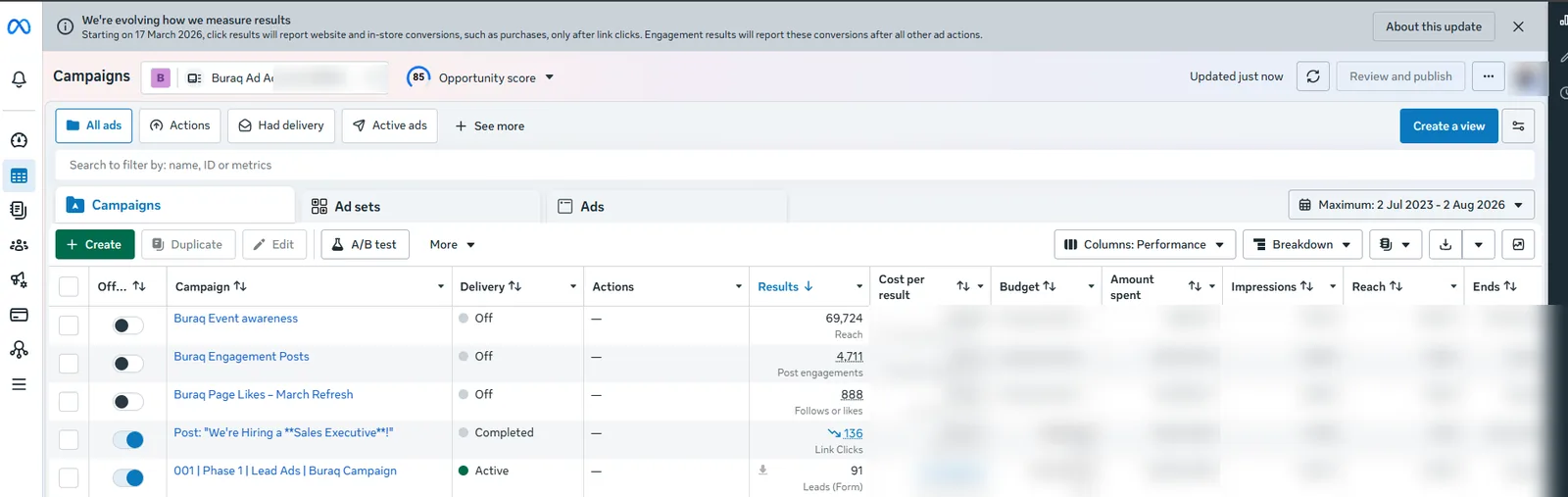
What the account shows
- Campaigns split by objective rather than bundled together
- A lead generation campaign named by phase, so the testing order is visible
- That campaign returning 91 form leads, which also confirms instant forms as the capture method
- Awareness and engagement campaigns switched off, the lead campaign still active
- A recruitment post run through the same account and completed
- Naming that tells you what a campaign is before you open it
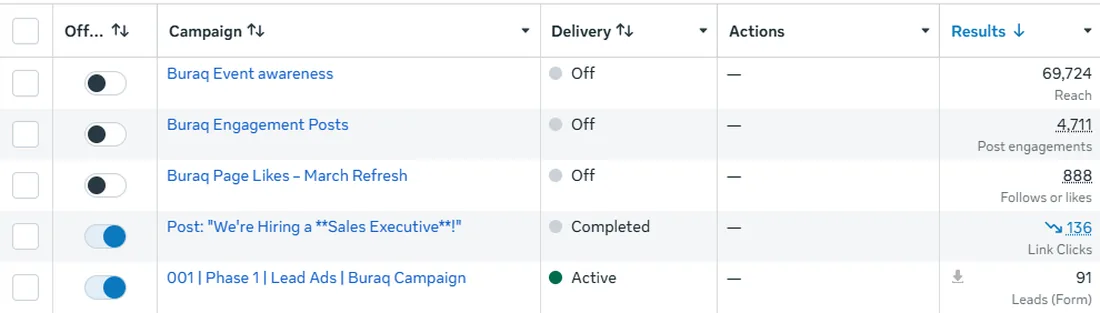
The lead campaign carries a phase number, so a later phase can be compared against an earlier one rather than replacing it silently.
Separating objectives keeps delivery honest. A campaign optimizing for engagement will not be judged on leads it was never asked to produce.
Results are shown. Cost per result, budget, spend, impressions, reach and scheduling stay masked, because what a campaign returned is the case study and what it cost the client is not mine to publish.
The cheapest lead is not always the most useful lead.
Platform cost is available immediately. Whether the enquiry was worth calling is only known after somebody calls it, which is why the review below depends on the sales team rather than the dashboard.
Reachable 01
- Valid contact details
- Number connects
- Not a duplicate submission
Relevant 02
- Location within the buyer market
- Interest in the project type
- Not an unrelated enquiry
Ready 03
- Purchase timeline
- Budget fit where collected
- Site visit interest
Responsive 04
- Answers the follow-up
- Recognises the enquiry
- Willing to continue
Reported 05
- Sales team feedback
- Patterns across a batch
- Which audience produced it
Acted on 06
- Audience adjustments
- Form question changes
- Creative changes
Campaign optimization should use sales feedback where available rather than relying only on platform cost.
Campaign management continued after launch.
Ongoing work split into three levels. The first can be checked quickly, the second needs a week of delivery behind it, and the third only exists once the sales team has spoken to people.
Delivery
Whether the campaign is running as intended. Fast to check and rarely the real problem.
- Delivery review
- Budget pacing
- Placement performance
- Frequency where relevant
Performance
Which parts of the setup are carrying the campaign. Needs enough delivery behind it to mean anything.
- Audience performance
- Creative performance
- Form completion
- Geographic performance
Usefulness
Whether the enquiries were worth having. The only level that answers the question the developer actually asked.
- Lead quality
- Duplicate enquiries
- Sales team feedback
- Campaign adjustments
- Creative refreshes
Not every fluctuation requires an immediate edit. Campaign changes need enough data and operational context
Construction progress supported campaign credibility.
A render shows intent. Progress shows delivery. For a development still under construction the second is the more persuasive of the two, and it is the only creative input that renews itself for free.
Trust
Work that visibly advances answers the question a render cannot, which is whether the project is actually being built.
Transparency
Showing the site as it is, rather than only as it will be, sets an expectation the sales conversation can meet.
Recency
Update content gives the campaign something current to say without changing the underlying offer.
Buyer confidence
Progress is the evidence a serious buyer looks for before committing time to a visit.
Retargeting
People who met the project earlier can be shown what has changed since, rather than the same frame again.
Sales conversations
A recent update gives the sales team a reason to make contact that is not simply a follow-up chase.
Construction progress supports credibility. It does not evidence investment quality, and nothing in this campaign presented it as though it did.
The campaign creates the enquiry. The sales process continues it.
This is the line the whole page depends on. Everything to the left of the sales contact below is mine. Everything to the right of it belongs to the people who sell the property.
My campaign role focused on generating and improving the quality of enquiries. The sales team remained responsible for contacting prospects, discussing the project, handling questions, arranging visits, and progressing property decisions.
My contribution across the campaign system.
Stating this precisely matters more on a property project than most. A development involves regulated, contractual and financial work that an advertising role does not touch.
The campaign system
Everything between a person not knowing the project exists and a salesperson having a reason to call them.
Scope
- Campaign planning
- Meta Ads setup
- Audience planning
- Geographic targeting
- Campaign structure
- Instant form setup
- Qualification questions
- Creative direction
- Campaign copy
- Project update content support
- Campaign monitoring
- Lead quality review
- Optimization
- Reporting
- Coordination with the client and sales team
- Ongoing campaign support
Outside my scope
The project and the transaction. None of this was mine, and the campaign only works because these are handled by the people who own them.
Not mine
- Property development
- Construction
- Unit sales and closing
- Legal documentation
- Financial advice
- Property valuation
- Investor verification
- Government approvals
- Payment collection
- Unit allocation
Why the line is drawn here
An advertising role can improve who enquires and what is known about them. It cannot value a unit, verify a buyer, or complete a sale, and a case study that blurs that is claiming credit for somebody else's work.
A clearer path from property campaign to sales conversation.
Stated as operational facts, with the one campaign figure the account evidences. No cost per lead, spend, sale, revenue or return figure is claimed, because none of those has been approved for publication.
- 01Campaigns ran against a defined commercial property offer rather than a general brand presence.
- 02Audience planning was organised into core, test, retargeting and broad layers.
- 03Geographic targeting was decided against the project location and the sales team's real coverage.
- 04Project creative communicated the development visually and consistently with the developer's own positioning.
- 05Instant forms collected contact and qualification information in one flow.
- 06Campaign structure separated objectives, so testing produced comparable results.
- 07Lead-quality feedback from the sales team informed optimization rather than platform cost alone.
- 08Project update content gave the campaign current material to work with.
- 09The active lead generation campaign returned 91 form leads, and enquiries reached the sales team with enough context to open a useful conversation.
What other commercial real estate projects can learn from this campaign.
Six things this build kept returning to, each tied to a decision that was actually made here.
The property offer must be clear
A building image alone does not explain why someone should enquire.
Audience size is not the only goal
A smaller relevant audience may be more useful than broad low-intent delivery.
Form questions affect lead usefulness
The sales team needs enough context to begin a productive conversation.
Creative needs regular project proof
Construction updates and real progress can support trust and campaign freshness.
Campaign metrics need sales feedback
A low platform cost does not automatically indicate a useful property enquiry.
The sales handoff matters
Advertising cannot replace the follow-up, consultation, visit, documentation, and decision process.
Inside the Buraq campaign and property story.
Everything held for this project, grouped by what it evidences, plus a plain statement of what is not held. Select any screenshot to open it full size.
Property project

Meta Ads
Not held for this project
Services used in this project.
This was a paid advertising engagement. The pages below cover the layer this work sits in and the layers a property campaign usually connects to next.
The layer this project sits in. Campaign structure, audience planning, creative direction, instant forms, qualification questions, and ongoing optimization.
Marketing automation servicesWhere a property enquiry goes after the form. Lead routing, enquiry status, follow-up, and the feedback loop back into the campaign.
Web design and developmentThe alternative to an instant form. Landing pages built so the project, the form, and the tracking line up with what the ad promised.
Related case studies
Sixth Sense Martial Arts
Meta Ads lead generation connected to a CRM pipeline, booking, follow-up and no-show recovery.
Ecommerce, TexasDallas Parrots
Website, SEO, Google and Meta campaigns, phone bookings and customer follow-up run as one system.
All projectsCase studies index
Every published case study, across ecommerce, property, hospitality, campaigns, and own products.
More on how I work is on the about page, and current availability is on contact
Connect your property campaign with a more useful enquiry process.
I can review your commercial property offer, target markets, Meta Ads account, campaign structure, creative, instant forms, qualification questions, sales handoff, lead-quality feedback, and reporting before defining the highest-priority improvements.