Conversion Systems 10 min read
The Marketing Automation Systems That Lift Conversions
Most automation setups are a handful of disconnected workflows. Conversions improve when every stage, from the first click to the closed sale, hands the lead cleanly to the next. The architecture, the handoffs, and how to build it without building everything at once.
On this page
Most businesses that say they have marketing automation have pieces of it. An autoresponder on the contact form. A CRM with a pipeline nobody trusts. A booking widget that does not talk to anything. Each piece works on its own, and the conversion rate barely moves.
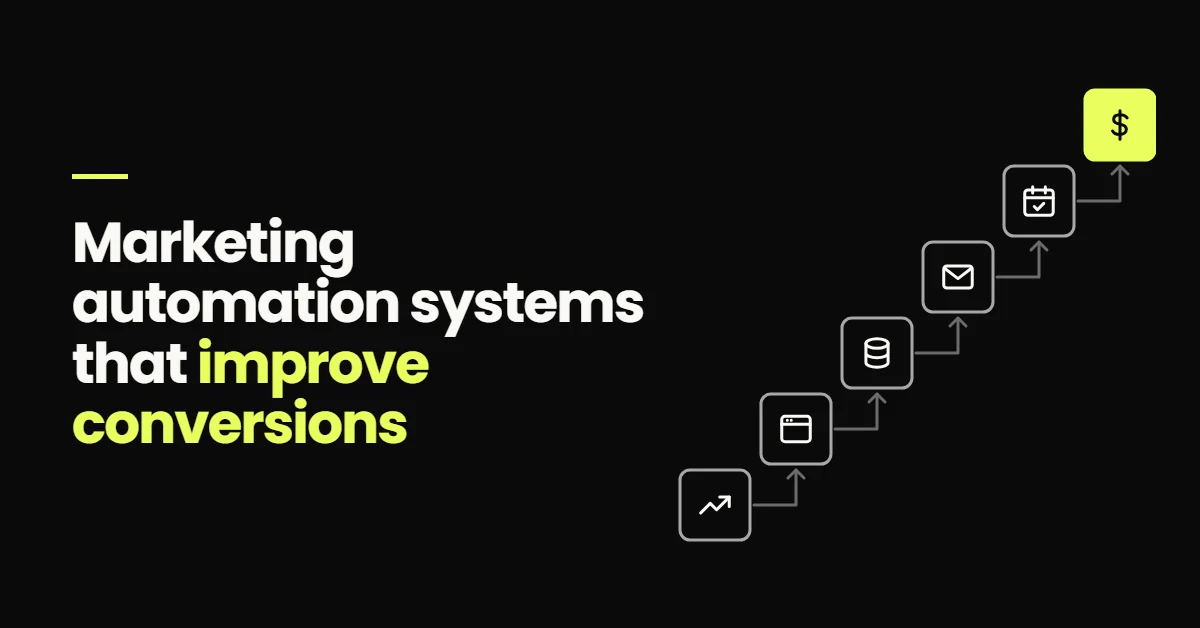
That is not because automation does not work. It is because conversion is a property of the whole journey. Marketing automation systems improve conversions when every stage, from the first visit to the closed sale and beyond, is connected, so leads move from one step to the next without falling into the gaps between tools and people.
A marketing automation system is the connected set of tools, rules and handoffs that moves a lead from first visit to sale: traffic lands on a page built to capture it, the lead enters a CRM with its source, routing and follow-up start immediately, booking and reminders run on their own, a person handles the sales conversation, unconverted leads are re-engaged, and revenue is attributed back to the source. It improves conversions by removing leaks between stages. An isolated automation fixes one step and usually moves the bottleneck somewhere else.
This is the advanced guide in the series. If you are new to the topic, start with what marketing automation is for service businesses.
Why isolated automations rarely improve conversions
A conversion rate is the product of every step a lead passes through. Improve one step and the lead still has to survive all the others. That is why a faster autoresponder on its own often changes very little: more leads get a quick reply, and then a similar share of them are lost at booking, on the sales call, or in the silence after a quote.
Isolated automation fails in predictable ways:
- 01The bottleneck moves Fixing first response exposes the slow booking process behind it.
- 02Data is lost between tools A form tool, a CRM and a calendar each hold part of the story, and none holds all of it.
- 03Nobody owns the gaps Marketing owns the ad, sales owns the call, and the handoff between them belongs to no one.
- 04Nothing is measured end to end Without source and outcome on the same record, you cannot tell which campaigns produce revenue.
Leaky system vs connected system
Leaky system
- Form, CRM and calendar out of sync
- Lead source lost after the form
- Handoffs depend on someone noticing
- Ad spend judged on cost per lead
Connected system
- One record from first click to sale
- Source carried through to revenue
- Every handoff triggered by an event
- Channels judged on booked and won work
The full architecture of a conversion system
A complete system has ten layers. Each has one job and hands something specific to the next.
A conversion system at a glance
- Traffic
- Website
- CRM
- Follow-up
- Booking
- Sale
1. Traffic
Job: bring the right people, not just more people. Hands off: visitors with a campaign and intent attached, through UTM parameters or call tracking. Search visibility and paid campaigns both live here, which is why SEO and paid advertising should be planned with the rest of the system rather than on their own.
2. Landing page or website
Job: turn a visit into an enquiry. Hands off: a form submission, call or chat with the source preserved. Pages need a clear next step, fast loading on mobile, and forms that pass tracking data into hidden fields. This is where web development meets automation.
3. Lead capture
Job: make sure every enquiry becomes a record. Hands off: a contact with source, service interest and consent. Every channel counts, including missed calls and social messages, which are the ones most often left out.
4. CRM
Job: hold one record per lead and one position in the pipeline. Hands off: a lead with a stage that later layers can act on. Designing stages that automation can move is the core of CRM automation.
5. Routing
Job: give every lead an owner. Hands off: a named person, notified, with a due time. It is the smallest layer and the one most often missing, which is why so many leads are seen by everyone and handled by no one.
6. Follow-up
Job: reach the lead quickly and keep trying until they respond. Hands off: a reply or a booking, with automation stopped. How to time those messages and when to stop them is explained in lead follow-up automation. AI chat and voice AI can extend this layer to website visitors and callers outside working hours.
7. Booking
Job: turn interest into a scheduled conversation and get the person there. Hands off: an attended appointment, recorded in the pipeline. See appointment booking automation.
8. Human sales
Job: close. This is the one layer automation should support rather than run. Hands off: a won or lost outcome with a reason. The system's job here is context: the source, the answers the lead gave, the conversation so far, and a reminder of what was promised.
9. Reactivation
Job: give unconverted leads and past customers a reason to come back. Hands off: re-engaged leads, returned to follow-up or booking. Timed check-ins, seasonal reminders and repeat-service prompts belong here.
10. Attribution
Job: connect revenue to its source. Hands off: decisions about where to spend next. With source and outcome on the same record, you can compare channels on booked and won work, and where an ad platform supports it, send qualified or won outcomes back so campaigns optimise for real customers rather than form fills.
The handoffs decide the conversion rate
Most of what a connected system gains comes from the handoffs, not the layers themselves. For each handoff, define three things:
- 01What data passes The source, answers and history the next stage needs. If it is not passed, it is lost.
- 02What event triggers it A form submission, a reply, a booking, an attended appointment. Not someone noticing.
- 03What the time limit is How long a lead can wait before the handoff is flagged. Speed matters most at the first response and at the sales handoff.
A useful exercise is to trace one real lead from the ad to the outcome and write down every point where a person had to copy, check or remember something. Each of those points is a handoff that can fail, and the list usually shows where to start.
Measuring conversion across the system
Measure the system stage by stage, not only at the end. These are the numbers that show where to work:
| Metric | What it tells you |
|---|---|
| Enquiries by source | Which channels produce interest |
| Time to first response | Whether follow-up is fast enough |
| Contact rate | How many leads you actually reach |
| Booking rate | How many reached leads schedule a conversation |
| Show rate | How many booked appointments happen |
| Close rate | How many conversations turn into work |
| Revenue by source | Which channels deserve more spend |
Take a baseline before you change anything, change one layer at a time, and compare like with like. Seasonal businesses should compare against the same period last year, not last month. I do not quote industry benchmarks for these rates, because they vary so much by service, price and lead source that your own baseline is the only reliable comparison.
What a connected system looks like in practice
The Dallas Parrots case study is a useful illustration because it was never a single-channel project. Monthly revenue grew from approximately $40K to approximately $126K within one year, alongside work on the website, SEO, Google Ads, Meta Ads, ecommerce management, phone bookings, customer follow-up, CRM and the sales process.
That result belongs to the whole combination, not to automation alone, and it is not a benchmark for any other business. The lesson is structural. Customers arrived through several channels and bought in several ways, online, after an enquiry or over the phone, and each of those paths had to work from end to end.
How to build the system without building everything at once
Build in the order that fixes the largest leak first, not the order the layers appear on a diagram. In practice:
-
01
Trace the journey Follow real leads from source to outcome and find where most are lost.
-
02
Capture and CRM Make sure every enquiry becomes a record with a source. Nothing else can be measured until this works.
-
03
Routing and follow-up Give every lead an owner and fast, persistent follow-up with stop rules.
-
04
Booking and the sales handoff Automate scheduling and reminders, and pass context to whoever runs the conversation.
-
05
Reactivation and attribution Re-engage the leads you already paid for, and tie revenue back to source.
-
06
Then scale traffic Once the system converts reliably, more traffic means more revenue instead of more waste.
The platform matters less than the connections. An all-in-one platform such as GoHighLevel removes most of the integration work between layers. A stack of separate tools can work too, provided every handoff is tested and monitored. Designing and building the whole system end to end is the work my marketing automation services cover.
Who needs a full system, and who needs one fix
Not every business needs all ten layers on day one. If there is a single obvious leak, such as missed calls or no follow-up after quotes, fix that first and measure the change. A full system makes sense when you run paid traffic, handle leads across several channels or people, or cannot currently say which marketing spend produces revenue.
- Conversion depends on every stage a lead passes through, so isolated automations usually move the bottleneck rather than remove it.
- A complete system runs from traffic and landing pages through capture, CRM, routing, follow-up, booking, human sales, reactivation and attribution.
- The handoffs matter most: define the data passed, the event that triggers each one and its time limit.
- Measure stage by stage against your own baseline instead of industry benchmarks.
- Fix the biggest leak first, and scale traffic only once the system converts reliably.
Frequently Asked Questions
A marketing automation system is the connected set of tools, rules and handoffs that moves a lead from first visit to sale. It typically includes a website or landing page, lead capture, a CRM, routing, automated follow-up, booking and reminders, support for the sales conversation, reactivation of unconverted leads, and attribution reporting. What makes it a system rather than a collection of automations is that every stage shares the same lead record and hands off to the next automatically.
Automate the steps that repeat for every lead and suffer when they are slow or forgotten: capturing enquiries, recording the source, assigning an owner, first response, follow-up before a reply, booking, reminders, no-show follow-up, reactivation and reporting. Keep the steps that need judgement with people, especially the sales conversation, pricing, complaints and anything after a lead has started talking to your team.
Most fail because they are built in isolation. A workflow fixes one step but does not connect to the stages before and after it, so data is lost between tools, handoffs depend on someone noticing, and the bottleneck simply moves. Other common causes are missing stop rules, duplicate or conflicting workflows, pipeline stages defined by opinion rather than events, and systems nobody reviews after launch.
It can, when it removes real leaks in your lead journey, such as slow first response, no follow-up, missed calls, forgotten reminders or leads without an owner. It will not fix a weak offer, poorly matched traffic or a sales process that does not work. Because results depend on where your leaks are, measure each stage before and after a change rather than expecting a standard percentage improvement.
The CRM holds the record: who the lead is, where they came from, what stage they are at and what has happened so far. Marketing automation acts on that record. It starts follow-up when a lead arrives, stops it when they reply, sends reminders when they book and re-engages them when they go quiet. Each action writes back to the CRM, which keeps the next automation accurate and makes end-to-end reporting possible.