Automotive SEO Case Study: Increasing Organic Clicks by 162%
This automotive dealership SEO engagement improved organic clicks by 162% and organic impressions by 166% through technical SEO, content improvements, website structure, local relevance, internal linking, and search-intent alignment.
The work focused on making the website easier for search engines to understand and more relevant to the way automotive customers search.
Search ConsolePerformance1 May to 17 Nov 2023
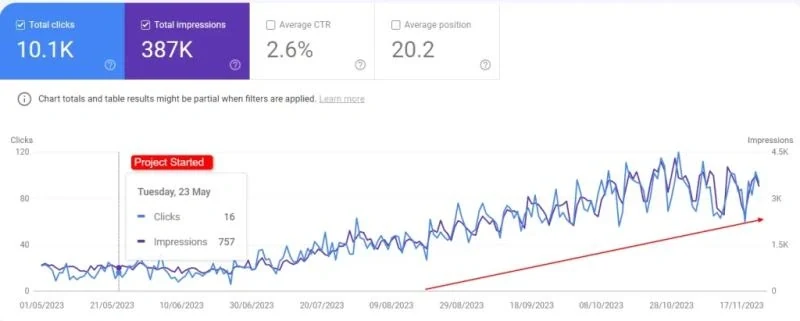
Clicks and impressions across the reporting window, with the project start marked on 23 May 2023. The percentages in the headline come from the engagement records, not from this capture.
- IndustryAutomotive dealership
- MarketSingapore
- ServiceSEO and organic growth
- FocusTechnical SEO, content, local search, website structure
- MeasurementGoogle Search Console
- Reporting window1 May to 17 Nov 2023
- Project start23 May 2023
- EngagementDelivered as part of an agency engagement
More visibility and more organic clicks.
Two figures, both from organic search. Read together they say the site was shown for more searches and that a larger share of those searches turned into a visit.
Organic clicks
People who saw the dealership in organic search and chose it over everything else on the result page. This is the figure that reflects whether the pages were worth clicking, not only whether they appeared.
Organic impressions
Times a page from the site appeared in organic results. Impressions moving first is the normal order. Coverage and relevance improve, then clicks follow if the listing matches what the searcher wanted.
These metrics reflect organic search performance during the SEO engagement. They do not represent verified vehicle sales, revenue, test drives, or leads.
SourceGoogle Search ConsolePerformance report1 May to 17 Nov 2023

The window totals as Search Console reports them. 10.1K clicks and 387K impressions across the period, at a 2.6% average click-through rate and an average position of 20.2. Note what an average position of 20.2 means. This was a visibility and relevance recovery, not a claim of top-of-page rankings.
Improving how the dealership appeared across automotive searches.
Automotive search behavior is fragmented. Customers may search by vehicle brand, model, body type, dealership location, used or new status, service requirement, price range, or comparison question.
The SEO work needed to align the website with those search patterns while improving technical quality and page structure.
The path a search has to complete
- 01Search query
- 02Search result
- 03Relevant page
- 04Inventory or information
- 05Enquiry or next action
Impressions measure step two. Clicks measure step three. Everything after that depends on the page the searcher lands on, which is why the work did not stop at rankings
One dealership competes for brand terms, model terms, service terms and location terms at the same time, and they do not all belong on one page.
A vehicle is researched over weeks. The same person searches informationally, then commercially, then locally.
Most dealership demand carries a market or location attached to it, whether or not the searcher types one.
Automotive search demand is spread across many intents.
A dealership site has to answer several different questions with several different pages. Trying to answer all of them on one page is the most common reason an automotive site underperforms for all of them.
Dealership
Searches for the business itself, its location, its opening details and its contact routes.
Brand
Searches for a manufacturer paired with a dealer or a market.
Model
Searches for a specific vehicle, often with a market or a year attached.
Condition
Used or new, which changes what the searcher expects the page to show.
Service
Servicing, maintenance and workshop searches, usually with a location attached.
Location
Searches naming an area, which need a page that is genuinely about that area.
Comparison
One vehicle against another, where the searcher wants a decision, not a listing.
Informational
Ownership, buying and suitability questions that come long before a purchase.
Areas the strategy was designed to address
Pages competing with each other
Several pages aiming at the same terms split the signals between them, so none of them establishes itself. Weak page targeting produces the same effect from the opposite direction, where a page is about nothing in particular.
Technical barriers to discovery
Crawl issues, unclear canonical signals and an unclear page hierarchy mean search engines cannot rank pages consistently even when the pages themselves are reasonable.
Thin vehicle and category pages
A listing with a photograph and a price answers less than the searcher asked.
Limited internal linking
Related pages that never reference each other leave both users and crawlers without a route between them.
Metadata and local alignment
Titles and descriptions that do not state what a page is for, and pages that carry no local signal in a market where nearly every search has one.
These are the areas the engagement reviewed and worked on. Where the original state was not documented, this page does not assert that every one of them was broken
Start by understanding what search engines and users can actually access.
The audit ran across six areas before any change was proposed. Identifying something here is not the same as fixing it, and this section is the review rather than the implementation.
Crawling 01
- Robots directives
- Sitemap
- Crawl paths
- Broken links
- Redirects
- Orphan pages
Indexing 02
- Indexed pages
- Duplicate pages
- Canonicals
- Thin pages
- Search Console coverage
Site structure 03
- Navigation
- URL structure
- Category relationships
- Brand and model hierarchy
- Internal links
On-page 04
- Titles
- H1s
- Metadata
- Content
- Images
- Structured data
Performance 05
- Mobile usability
- Load behavior
- Image weight
- Layout shift
- Core Web Vitals risks
Local relevance 06
- Location signals
- Dealership information
- Service areas
- Local pages
- Business profile signals
Map each search to the page that should answer it.
Keyword research was used to decide which existing page should be improved, which content gap required a new page, and which terms should not be forced onto the same URL.
IntentQuery shapePage that should answer it
A brand page that establishes the dealership's relationship with that manufacturer and routes into the relevant stock.
A model page, not a filtered inventory view, because the searcher wants the vehicle explained before they see a price.
A category page carrying the condition and the market, with the inventory reachable from it.
A page that is genuinely about that area rather than the same copy with a place name swapped in.
A service page, kept separate from the sales pages, because the searcher is not buying a vehicle.
A comparison page that reaches a conclusion, then links to both models rather than ending on a listing.
A guide, which exists to be useful early and to pass the reader on to the model and category pages.
Query shapes above are generic patterns, not the client's keyword set. The engagement's research data belongs to the dealership and the agency, so it is not published
Remove the technical barriers before scaling content.
Technical work ran first because everything after it depends on pages being reachable, indexable and unambiguous. Publishing more content onto a site search engines cannot read properly multiplies the problem instead of solving it.
Making sure the pages that matter can be reached, and that crawl budget is not spent on pages that do not.
Reviewing what is actually in the index against what should be, then resolving the difference.
One preferred URL per piece of content, so near duplicate inventory views do not compete with each other.
Old and retired URLs pointing at their successor in a single hop rather than a chain.
A sitemap that reflects the live, canonical, indexable set and nothing else.
URLs that describe the hierarchy they sit in, so the path itself carries meaning.
Titles and descriptions written to a pattern per page type rather than one at a time.
One H1 per page and a heading order that matches the content beneath it.
Templated pages that differ only by a place name or a filter, which need either a reason to exist or consolidation.
Internal links to pages that no longer resolve, which waste crawl and frustrate visitors equally.
Weight, dimensions and alt text, which on an inventory site is a performance question as much as an accessibility one.
The experience most automotive search traffic actually arrives on.
Markup that describes what a page is, applied where it genuinely fits the page type.
Technical SEO created a stronger foundation, but relevance and content still determined whether pages matched automotive search intent.
Vehicle, brand, service, and location pages need clear relationships.
A clear hierarchy helps users navigate the inventory and helps search engines understand how pages relate. Three routes had to work independently and still connect to each other.
Inventory route
- Homepage
- Vehicle inventory
- Brand
- Model
- Vehicle detail
The commercial spine. Each level narrows the choice and each level can be the entry point from search, so none of them can depend on the one above it for context.
Service route
- Homepage
- Services
- Service type
- Location
Kept separate from the sales spine. A servicing search and a buying search are different jobs, and merging them costs both.
Research route
- Homepage
- Guides
- Comparisons
- Buying information
Where informational demand lands. Its value is in feeding the other two routes rather than converting on its own.
Structure work of this kind sits alongside the build itself, which is covered under web design and development services
Make each page clear about what it should rank for.
Every page was treated as an answer to one question. If a page could not be described in a sentence, that was the problem to solve before touching anything else on it.
State the page, then the market
A title that names the vehicle, service or category and the market it serves, written to a pattern per page type so the whole site stays consistent.
One H1, then a readable order
A single H1 naming the page subject, with H2s that follow the order a visitor would actually ask the questions in.
Answer the question the query asked
Vehicle and service information written for the decision the searcher is making, with the local context the market expects.
Alt text, links and next steps
Image alt text that describes the vehicle, internal links to the pages a reader would want next, and a call to action that suits the page type.
Automotive content should help customers make a decision.
Content was planned around actual search intent rather than publishing generic automotive articles. Each type below exists to answer a specific stage, and each one hands the reader to the next.
Model and category pages
- What the vehicle is and who it suits
- Condition and market context
- Route into the matching stock
Comparison content
- Two vehicles judged against each other
- A stated conclusion rather than a table alone
- Links to both model pages
Buying and ownership guides
- Questions asked before a shortlist exists
- Local ownership context
- Handover into category pages
Service pages
- What the workshop does
- Location and access
- Kept clear of the sales journey
Location pages
- Genuinely about the area
- Dealership details and directions
- Not a template with a place name swapped
Dealership information
- Who the business is
- Contact and enquiry routes
- The page brand searches land on
No single article is credited with a result on this page. Content contributed alongside the technical, structural and local work, and separating them would require attribution data this engagement does not have.
Connect related automotive pages so users and search engines can move through the site.
Three link paths, each one closing a loop that would otherwise dead end. The point is that every page has somewhere sensible to send the reader next.
Inventory path
- 01Brand page
- 02Model page
- 03Vehicle page
Research path
- 01Guide
- 02Category page
- 03Inventory
Service path
- 01Service page
- 02Location page
- 03Contact
A link from a brand page to a model page states that they belong together, which a shared navigation does not do on its own.
A page nothing links to is a page search engines have little reason to revisit.
Shorter routes from the homepage to the pages that matter, rather than depth for its own sake.
The reader of a comparison usually wants a model page next. Making that link explicit is the whole job.
Link value moves along these paths, which is why they run toward commercial pages and not away from them.
New pages get found faster when existing pages point at them deliberately.
No internal link count is published here. The paths above describe the structures used, not a measured total
Dealership searches often carry strong location intent.
Singapore is a single dense market, which makes local relevance less about covering many towns and more about being unambiguous on the one market the dealership serves.
Signals on the site
- Location relevance in page copy
- Dealership details published consistently
- Local landing pages
- NAP consistency
- Service area content
- Local keywords in titles and headings
Signals off the page
- Business profile information
- Internal linking into local pages
- Mobile call actions
- Directions and contact routes
- Consistency between profile and site
- Market context rather than town spam
The same local approach is described on the SEO and organic growth services page
Use query and page data to decide what to improve next.
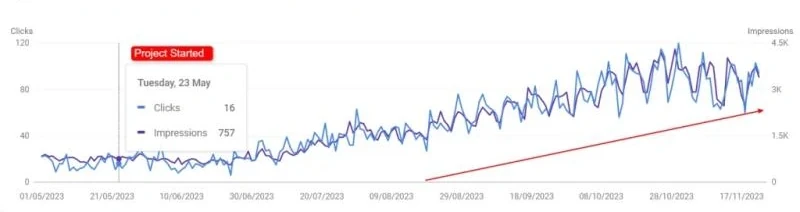
Clicks and impressions were reviewed alongside the pages and queries producing them. A total on its own tells you something moved. It does not tell you what to do on Monday.
Search ConsolePerformanceClicks and impressions1 May to 17 Nov 2023
The report the engagement was steered from. The capture carries no property name, domain, account email or user detail, which is why it can be published without redaction.
Which searches the site appears for, and which of them the pages actually deserve.
Which page each query resolves to, which is where intent mismatches surface.
Average position read as a direction of travel, never quoted as a ranking claim.
Mobile against desktop, because automotive search skews to the phone.
What is indexed against what should be, checked rather than assumed.
A page gaining impressions but not clicks is a title and relevance problem. A page losing both is usually a technical or a targeting one. The distinction is what makes the report actionable
My contribution across the SEO engagement.
Delivered as part of an agency engagement. The dealership was not a direct personal client, and the search work sat alongside a wider team.
The search engagement
Everything between a customer typing a search and landing on a page that answers it.
Scope
- SEO audit
- Keyword research
- Competitor analysis
- Search-intent mapping
- Technical SEO review
- On-page SEO
- Content strategy
- Website structure recommendations
- Internal linking
- Local SEO
- Search Console monitoring
- Reporting
- Team coordination
- Ongoing optimization
Outside my scope
The business itself. Search work brings a customer to the forecourt. What happens there was never mine.
Not mine
- Vehicle sales
- Inventory management
- Pricing
- Financing
- Test drive appointments
- Dealership operations
- Customer service
- Vehicle imports
- Legal compliance
Why the attribution is stated
An agency engagement means the result belongs to a team and a client, not to one person. Claiming a dealership as a direct client would misrepresent how the work was delivered.
The growth came from several SEO improvements working together.
Each area below moved a different part of the same result. No percentage is assigned to any of them, because separating their effect would need attribution data this engagement does not have.
Better technical access
Pages that can be crawled, indexed and resolved to one canonical URL are pages that can compete at all.
Clearer page targeting
One page per question, so the site stops competing with itself for the same terms.
Stronger website structure
Hierarchy that both a visitor and a crawler can follow from the homepage to a vehicle.
Search-intent alignment
The page that appears matches what the query asked for, which is where impressions turn into clicks.
More useful content
Pages that answer the decision rather than restating the listing.
Improved internal linking
Routes between related pages, so discovery and relevance reinforce each other.
Stronger local relevance
Unambiguous market signals in a category where nearly every search carries one.
Ongoing Search Console analysis
Each round of changes informed by what the last round actually did.
The verified click and impression growth should be understood as the result of the combined SEO system, not as the output of any single change listed above.
A stronger organic search foundation for the dealership.
What the engagement left behind, stated as verified figures and operational facts.
- 01Organic clicks increased by 162%.
- 02Organic impressions increased by 166%.
- 03Search visibility improved across the reporting window.
- 04More search users reached the website.
- 05Technical, structural, content and local improvements supported the search work together.
- 06Pages were mapped to the intents they were meant to answer.
- 07Internal linking connected the inventory, research and service routes.
- 08Local relevance was made unambiguous for the market the dealership serves.
- 09Search Console data guided ongoing decisions rather than only reporting on them.
Organic traffic growth does not automatically equal the same percentage growth in vehicle sales.
What automotive businesses can learn from this SEO engagement.
Six things this engagement kept confirming, each tied to a decision that was actually made here.
Search intent is fragmented
Customers search by brand, model, service, condition, location, and question.
Inventory alone is not an SEO strategy
The website still needs structure, relevant pages, content, and internal links.
Technical SEO affects discovery
Search engines cannot rank pages consistently if crawling, indexing, or canonical signals are unclear.
Local intent matters
Dealership and service searches are often connected with a specific market or location.
Content should support decisions
Useful content helps customers compare, understand, and move toward the right page.
Reporting should guide implementation
Search Console data is most useful when it leads to specific page and technical improvements.
Inside the automotive SEO work.
One capture exists for this engagement, shown in full and in detail, plus a plain statement of what is not held. Select any screenshot to open it full size.
Verified results
Not held for this engagement
Services used in this project.
This was a search engagement. The pages below cover the layer the work sits in and the layer it depends on.
The layer this project sits in. Technical SEO, keyword and intent research, on-page work, content strategy, internal linking, local relevance, and Search Console measurement.
Web design and developmentThe site the search work runs on. Page templates, URL structure, mobile experience, and the technical foundation an inventory site needs before content scales.
Marketing automation servicesWhat happens after the click. Enquiry capture, lead routing, follow-up, and the reporting that connects a search visit to an actual conversation.
Related case studies
Dallas Parrots
SEO running alongside Google Ads, Meta Ads, website work and phone bookings as one connected system.
Commercial property, PakistanBuraq Business Center
Meta Ads lead generation for a commercial development, built around instant forms and lead quality.
All projectsCase studies index
Every published case study, across ecommerce, property, automotive, hospitality, campaigns, and own products.
More on how I work is on the about page, and current availability is on contact
Find what is limiting your automotive search visibility.
I can review your dealership website, technical SEO, inventory structure, brand and model pages, local visibility, content, internal links, Search Console data, and conversion paths before defining the highest-priority improvements.