Healthcare SEO Case Study: Growing Monthly Organic Visitors from 59M to 82.3M
This large health publisher increased monthly organic visitors from 59 million to 82.3 million through a connected SEO system covering technical quality, search intent, content strategy, internal linking, editorial execution, and ongoing performance analysis.
I helped lead and manage the SEO operation across strategy, content planning, technical review, implementation, reporting, and coordination with a team of more than 30 people.
Monthly organic trafficThird party estimateSep 2022 to Jul 2024
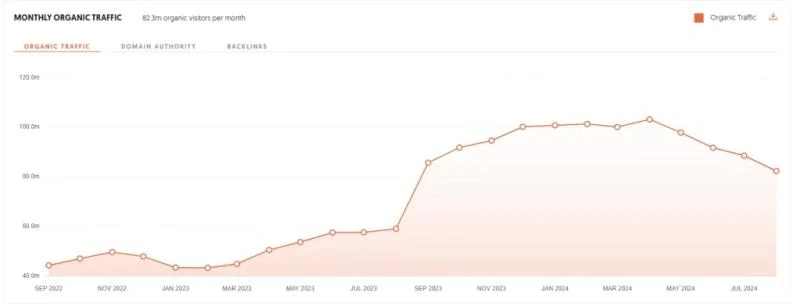
The chart reads 82.3m organic visitors per month. It rises through the second half of 2023, peaks above 100m in early 2024, and settles back to 82.3m by the end of the window. The 59M baseline is not printed on it and comes from the engagement records.
- IndustryHealth publishing and medical information
- ServiceSEO and organic growth
- ScaleLarge publisher
- FocusTechnical SEO, content strategy, internal linking, editorial SEO
- MetricMonthly organic visitors
- SourceThird party SEO tool estimate
- TeamSEO operation of more than 30 people
- EngagementDelivered as part of an agency engagement
59M to 82.3M monthly organic visitors.
Growth in monthly organic visitors during the SEO engagement. The chart behind it does something most case studies crop out, so this section shows the whole shape rather than the flattering part of it.
at the reference point in the
engagement records
2024 before settling. Read off the
axis, not a stated figure
tool reports them at the end
of the window
This represents organic audience growth. It does not represent verified revenue, medical outcomes, leads, subscriptions, or conversions.
SourceThird party SEO toolMonthly organic trafficSep 2022 to Jul 2024

The reading the tool prints, with the metric name intact. This is monthly organic visitors, not sessions, users, pageviews or visits, and the page keeps that wording everywhere.
SEO at publisher scale requires systems, not isolated fixes.
A large health publisher may have thousands of articles, categories, topic hubs, templates, internal links, technical dependencies, and editorial workflows.
The work required coordination across SEO, content, editorial, development, reporting, and ongoing performance analysis.
The system the work had to keep running
- 01Search demand
- 02Topic strategy
- 03Content
- 04Technical delivery
- 05Internal links
- 06Indexation
- 07Organic audience
- 08Performance review
Every stage feeds the one after it and reports back to the one before it. Break any single link and the loop stops improving
At this scale the question is rarely how to fix one page. It is how to make a decision that applies correctly to several thousand.
SEO informed relevance and structure. Writing, editing and medical review stayed with the publisher's own teams.
A recommendation only becomes a result once content, development and editorial have all moved on it.
Small inconsistencies become large problems across thousands of pages.
These are the areas the engagement was built to review and address. Where the original state was not documented, this page does not assert that every one of them was a live problem.
Pages competing for the same intent
On a site with thousands of articles, several pages drifting toward the same question is the default state rather than the exception. Duplicate and near-duplicate pages split the signals between them and none of them settles.
Content that used to work
Thin or outdated articles, and previously strong pages that quietly decline as search behavior and competition move underneath them.
Weak topic relationships
Articles that belong together without anything saying so, plus limited internal linking that leaves both readers and crawlers without a route between them.
Issues that multiply
Inconsistent metadata, crawl inefficiency, indexation problems and template-level technical faults, each one applying to every page built on that template.
Reporting disconnected from work
Weak prioritization, and content production that continues without a performance review deciding what should have been produced.
At publisher scale, the priority is not simply creating more pages. The priority is improving which pages exist, what they target, how they connect, and how they perform.
Build a system for deciding what to create, improve, merge, or remove.
The strategy was a repeatable loop rather than a plan with an end date. Each pass through it produced the input for the next one.
Start from what the site already earns rather than from a keyword list.
Where demand exists that the site is not credibly serving yet.
What each query actually wants, before deciding what to publish for it.
Whether an answer already exists somewhere in the archive, which it usually does.
Questions with no page that owns them.
Questions with several pages competing to own them.
Template faults first, because they carry the widest effect per fix.
The pages already close to earning more, before the ones starting from nothing.
Internal links that state which pages belong to which subject.
Read what the last pass did, then run the loop again on what it revealed.
The decision every page has to pass through
- 01Page or topic
- 02Keep
- 03Improve
- 04Expand
- 05Merge
- 06Redirect
- 07Remove
The framework above is the decision set. This page does not state how many pages ended in each outcome, because that count is not published
Health searches vary by question, condition, symptom, treatment, and stage of understanding.
Search-intent mapping helped define which page should answer each question and where pages risked competing with each other. Query shapes below are generic patterns, not the publisher's keyword set.
Definition
What is [topic]?The entry point. Usually the shortest answer and the widest audience.
Symptom
Symptoms of [condition]Someone trying to recognise something. Structure matters more than length here.
Cause
What causes [condition]?Explanation rather than instruction, and frequently confused with the symptom page.
Treatment
How is [condition] treated?The page most likely to be pulled toward several intents at once.
Comparison
[Option A] vs [Option B]A reader who wants the difference stated, not two descriptions side by side.
Prevention
How to reduce the risk of [topic]Forward looking, and usually a different reader from the symptom page.
Recovery
What to expect after [procedure]Time based. The reader wants a sequence rather than a definition.
Medication
Uses and side effects of [medication]Highly specific, and the cluster where page ownership has to be unambiguous.
The examples above are placeholders for query shapes. Nothing on this page is medical guidance, and no clinical claim is made or implied by them
Not every page deserves the same priority.
Two variables decide where the effort goes. How much a topic is worth to the publisher, and how well the page currently serving it performs. The combination gives three different jobs.
Weak performance
Improve first
The largest gap between what a page could earn and what it earns now. These are the pages where a week of work moves the most, because the demand is already proven and only the page is holding it back.
Work it this cycleStrong performance
Protect and expand
Already working, and therefore the most expensive thing to break. These get monitored for decay, defended against overlap from newer pages, and extended where the topic has room.
Monitor for decayDuplicate intent
Review for consolidation
Pages competing with a better page on the same site. The review decides whether each one earns its place, gets merged into the stronger page, or is left alone.
Merge, keep or leaveSignals the review reads
Demand 01
- Organic clicks
- Impressions
- Search queries
Position 02
- Current rankings
- Traffic decline
- Growth potential
Fit 03
- Search-intent match
- Topic importance
- Editorial importance
Condition 04
- Content age
- Content quality
- Depth against the query
Connection 05
- Internal links in
- Internal links out
- Orphan status
Access 06
- Indexation
- Canonical state
- Template inherited issues
No page count is published. The model above describes how pages were sorted, not how many landed in each bucket
Template and crawl issues can affect thousands of pages at once.
On a large publisher, one template-level improvement can affect far more pages than a manual page-by-page fix. That is the whole reason technical work gets sequenced ahead of content work.
Crawl 01
- Crawlability
- Robots directives
- XML sitemap
- Crawl efficiency
- Broken links
- Orphan pages
Index 02
- Indexation
- Canonicals
- Duplicate content
- Pagination
- Near duplicate templates
Structure 03
- Taxonomy
- URL structure
- Internal links
- Redirects
- Category relationships
Template 04
- Metadata templates
- Heading structure
- Structured data
- Related content modules
Delivery 05
- Mobile usability
- Image loading
- Core Web Vitals risks
- Render behavior
Sequence 06
- Widest effect first
- Template before page
- Verified before scaled
- Re-checked after release
Improve existing pages before assuming more content is the answer.
An archive this size already contains an answer to most questions worth answering. The faster route is usually making the existing answer match the query rather than writing a second one beside it.
What an optimization pass looked at
- Search-intent alignment between the query and what the page delivers
- Headline and title clarity
- Heading structure and the order questions are answered in
- Subtopics the query implies and the page omits
- Content clarity for a non-specialist reader
- Terminology consistency across related pages
- Internal links in and out of the page
- Metadata against what the page actually covers
- Frequently asked questions where the format genuinely fits
- The introduction, which decides whether the rest is read
- Content depth measured against the query rather than a word count
- Visual support where an explanation needs it
- How sources are presented
- Update signals on pages where recency matters
- Calls through to the related content a reader would want next
The publisher's editorial and medical-review standards remained separate from SEO recommendations. I did not review, approve or verify medical content, and nothing in this engagement replaced that process.
Turn search research into clear editorial instructions.
Research that stays in a spreadsheet changes nothing. The brief is where analysis becomes something a writer can act on without having to redo the analysis.
Primary search intent
What the reader arriving on this page is actually trying to find out.
Main topic
The single subject the page owns, stated so it cannot drift.
Supporting questions
The related questions the page should answer while it is there.
Recommended structure
A heading order that follows how the reader would ask.
Competing pages
Existing pages on the same site that already touch this topic.
Internal link targets
Which pages this one should point at, and which should point back.
Metadata direction
Title and description written to the page's job, not to a formula.
Search result observations
What the results page currently rewards for this query.
SEO briefs guided search relevance. Writers and editors remained responsible for producing clear, useful content, and the publisher's own review process remained responsible for medical accuracy.
Connect individual articles into understandable topic systems.
An article that nothing links to and that links nowhere is a page the site has no opinion about. Linking is how an archive states which pages belong to which subject.
Topic path
- 01Topic hub
- 02Condition guide
- 03Symptom page
- 04Treatment page
- 05Related article
Reader path
- 01Article
- 02Supporting explanation
- 03Related condition
- 04Next question
The next question a reader has is usually predictable. Linking to it is the difference between one page and a session.
Deep archive pages get found through the pages above them, not through the homepage.
A page nothing links to has little reason to be recrawled and less reason to be trusted.
Links state that two pages are about the same subject, which navigation alone does not.
Shorter routes to the pages that matter, rather than depth accumulating by default.
Established pages can carry newer supporting pages, which is the cheapest distribution the site owns.
No internal link count is published here. The paths above describe the structures used, not a measured total
Large publishers need clear relationships between topics, categories, and articles.
Taxonomy affects navigation, crawling, internal links, user discovery, and how search engines interpret topical relationships. On a site this size it is the single decision with the widest reach.
Almost never the entry point for an archive page, and therefore not the thing to optimize first.
The broadest grouping. Its job is to establish that the publisher covers the subject at all.
Where the topic becomes specific enough that a reader recognises their own question in it.
Symptom, cause, treatment, comparison. This level is what stops two articles competing for the same intent.
The page that actually answers a query, and the page most organic arrivals land on directly.
The levels above describe the shape a health archive needs. Specific category names from the publisher's own taxonomy are not published
Strong pages still need monitoring.
A page that performs today is not finished. The chart in section 01 is the honest version of this point, because it shows a peak followed by a decline on a property that was still being worked on.
Search behavior changes, competing pages appear, and results pages change shape. A refresh improves the odds. It does not promise recovery
Large-scale SEO depends on clear responsibilities.
The SEO operation on this engagement ran with more than 30 people across it. At that size, the constraint stops being what to do and becomes how reliably a decision travels from analysis to a published page.
- SEO strategists
- Keyword researchers
- Content planners
- Writers
- Editors
- Technical SEO specialists
- Developers
- Analysts
- Quality reviewers
Medical reviewers sat inside the publisher's own editorial process and were not part of the SEO reporting line
Traffic growth needs page-level and query-level analysis.
Top-line traffic is useful, but implementation decisions require understanding which pages and queries changed. A number that moves without a reason attached to it cannot be repeated.
Top line
Whether the property is growing. Fast to read, and the level that answers the least.
- Clicks
- Impressions
- Overall trend
Segment
Where the movement sits. This is the level that turns a chart into a shortlist.
- Landing pages
- Topic groups
- Device
- Country where relevant
- Index coverage
Cause
Why it moved. The only level that changes what the team does next.
- Queries
- New query patterns
- Page overlap
- Traffic decline
- Growth opportunities
My contribution across strategy, execution, and reporting.
Delivered as part of an agency engagement. On a property this size no individual owns the result, and the line between search work and publishing work matters more here than on any other project on this site.
The search operation
Deciding what the site should target, why, in what order, and whether the last decision worked.
Scope
- SEO strategy
- Keyword research
- Search-intent mapping
- Content prioritization
- Technical SEO review
- On-page SEO
- Content optimization
- Internal-linking strategy
- Editorial SEO guidance
- Search Console analysis
- Reporting
- Team leadership
- Coordination with writers, editors, developers and analysts
- Ongoing optimization
Outside my scope
The publication itself. This distinction is not a formality on a health property.
Not mine
- Medical review
- Clinical guidance
- Editorial ownership
- Publisher revenue management
- Advertising sales
- Product management
Why this line is drawn hard
I am not a medical professional and never acted as one. I did not diagnose, approve medical advice, verify medical accuracy, or replace a medical reviewer. Search work decided which questions the site should answer well. Whether the answer was medically correct was decided by people qualified to decide it.
The growth came from several systems working together.
No percentage is assigned to any factor below. Separating their effect on a property of this size would need attribution data this engagement does not have, and any split offered without it would be a guess presented as a measurement.
Stronger technical foundations
Template and crawl work, where a single change applies correctly across a large part of the archive.
Better search-intent alignment
Pages matched to what their queries actually want, which is where impressions become visits.
More focused content priorities
Effort concentrated on the pages with the largest gap between potential and performance.
Existing-content improvements
The archive treated as an asset to improve rather than a backlog to add to.
Clearer internal linking
Routes between related pages, so discovery and topical relevance reinforce each other.
Stronger topic structure
A taxonomy that states which pages belong together and which own which intent.
Consistent editorial execution
Briefs that reached writers in a usable state, cycle after cycle.
Ongoing performance review
Each round of work informed by what the last round actually did.
Team coordination at scale
More than 30 people moving on the same priorities rather than on parallel ones.
The verified audience growth belongs to the combined SEO and editorial system. It is not the output of any single change listed above, and it is not attributable to any one person.
A stronger organic growth operation at publisher scale.
What the engagement left behind, stated as the verified figure and operational facts.
- 01Monthly organic visitors increased from 59M to 82.3M.
- 02SEO strategy and editorial execution were connected rather than run in parallel.
- 03Search intent informed content planning instead of following it.
- 04Existing pages were reviewed as growth assets rather than finished work.
- 05Technical SEO supported discoverability at template scale.
- 06Internal linking supported topic relationships across the archive.
- 07Content decay was monitored rather than discovered late.
- 08Performance analysis guided ongoing decisions, and the team structure supported implementation at scale.
Organic audience growth does not automatically equal the same percentage growth in revenue, subscriptions, or healthcare outcomes.
What large publishers can learn from this SEO engagement.
Seven things this engagement kept confirming, each tied to a decision that was actually made here.
More content is not always the answer
Existing pages may need clearer intent, stronger structure, and better internal links.
Template issues scale quickly
One technical problem can affect thousands of URLs.
Search intent should guide page ownership
Each meaningful query should have a clear page designed to answer it.
Content decay needs monitoring
Previously successful pages can decline when search behavior and competition change.
Internal linking is part of the editorial system
Related pages should help users and search engines understand the topic.
Reporting must lead to action
Traffic data is useful when it changes page, content, or technical priorities.
Large-scale SEO requires operational discipline
Strategy, editorial work, technical implementation, review, and measurement must remain connected.
Inside the health publisher SEO operation.
One chart exists for this engagement, shown in full and in detail, plus a plain statement of what is not held and why. Select any screenshot to open it full size.
Verified traffic
Not held for this engagement
Services used in this project.
This was a search engagement at scale. The pages below cover the layer the work sits in and the layer it depends on.
The layer this project sits in. Technical SEO for publishers, search-intent research, content prioritization, editorial SEO strategy, internal linking for large websites, and performance analysis.
Web design and developmentThe templates search work runs on. Page structure, taxonomy, URL patterns, related content modules, and the technical foundation a large archive depends on.
Marketing automation servicesWhat happens after the visit. Capturing and routing interest, follow-up, and the reporting that connects an organic arrival to something measurable.
Related case studies
Automotive dealership SEO
The same search discipline on a smaller property, with technical SEO, intent mapping and internal linking steered from Search Console.
Ecommerce, TexasDallas Parrots
SEO running alongside Google Ads, Meta Ads, website work and phone bookings as one connected system.
All projectsCase studies index
Every published case study, across publishing, automotive, ecommerce, property, hospitality, campaigns, and own products.
More on how I work is on the about page, and current availability is on contact
Find what is limiting organic growth across your publishing system.
I can review your website structure, technical SEO, content inventory, search intent, internal links, editorial process, Search Console data, content decay, and reporting before defining the highest-priority improvements.